Most hotel deals are legitimate. Some are simply more complicated than they first appear. And a few quietly begin revealing patterns that sophisticated buyers learn to recognize early—before costly surprises appear after closing.

Most hotel deals are legitimate.
Many sellers are honest.
Many brokers work professionally.
And many transactions move exactly the way they should.
But experienced hotel buyers eventually learn something important:
Not every opportunity is as clean as it first appears.
Sometimes the problem is not obvious.
The numbers look attractive.
The story sounds polished.
Momentum builds quickly.
And quietly—
small inconsistencies begin surfacing.
A missing detail.
A rushed timeline.
Financials that somehow feel too perfect.
Individually, they seem manageable.
Together—
they can signal something more important:
The deal deserves deeper scrutiny.
Because sophisticated buyers understand something many people learn too late:
Risk rarely announces itself loudly.
It shows up quietly.
In patterns.
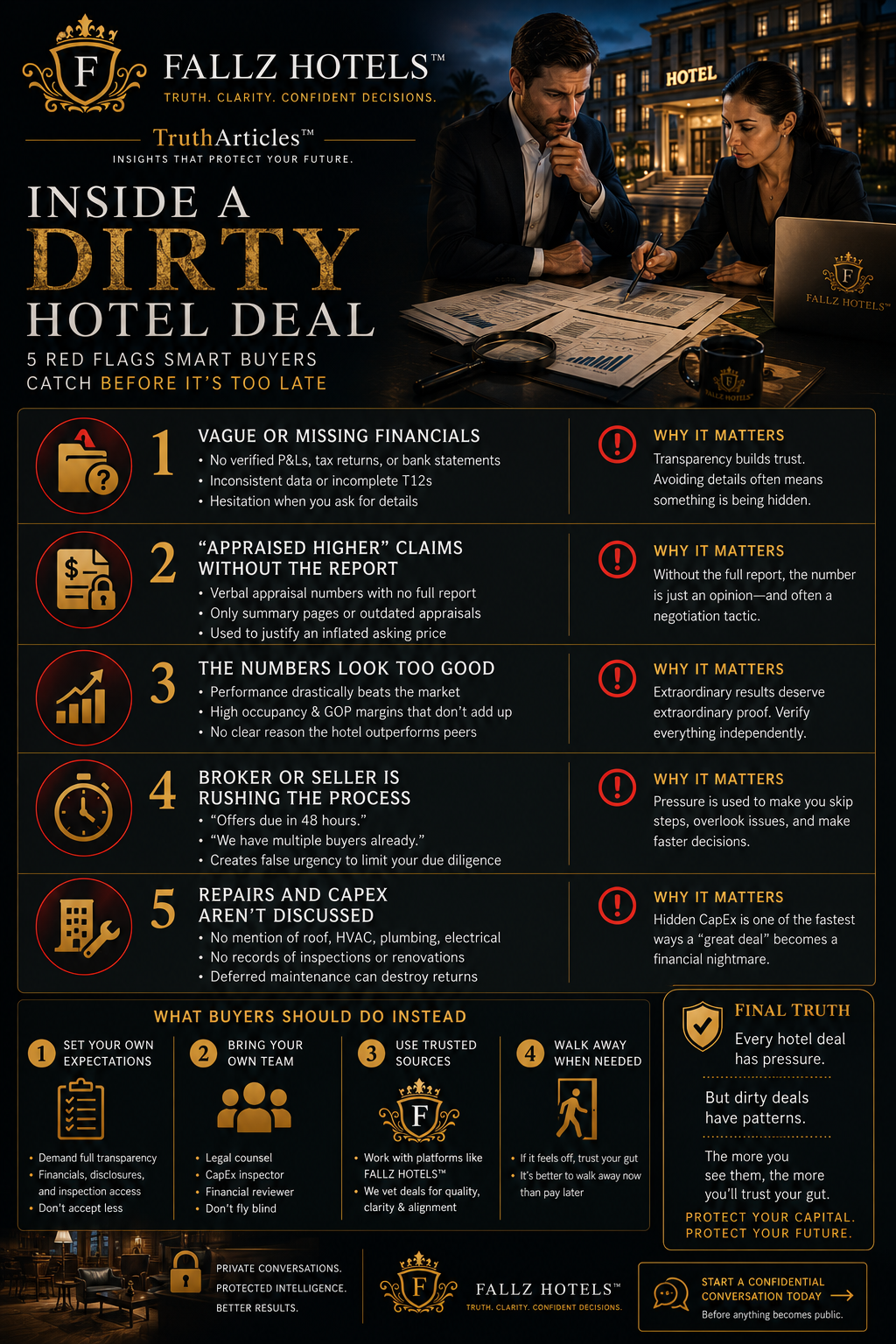
One of the earliest warning signs in any hotel acquisition is resistance around financial transparency.
You ask for trailing performance.
You receive summaries.
You ask for supporting documentation.
The process slows.
Answers become vague.
Or strangely inconsistent.
Sophisticated buyers usually want clarity around:
• Verified P&Ls
• Trailing financial performance
• Occupancy trends
• ADR and RevPAR consistency
• Expense patterns
• Tax filings where appropriate
This does not mean sellers must reveal everything immediately.
That would not always be reasonable either.
But experienced buyers pay attention when important information repeatedly feels difficult to access.
Because sometimes the issue is not what is missing.
It is why it feels missing.
This one deserves honesty.
Sometimes hotels genuinely outperform expectations.
Strong operators exist.
Great assets exist.
Undervalued opportunities exist.
But sophisticated buyers still pause when performance looks materially stronger than the surrounding market.
For example:
A struggling submarket.
Yet unusually high occupancy.
Aggressive ADR growth.
Margins far above comparable operations.
That does not automatically mean something improper happened.
But it does invite questions.
Strong buyers quietly ask:
• Why is this asset outperforming so dramatically?
• What assumptions support this performance?
• Is performance sustainable—or temporary?
• What external data validates this story?
Because experienced buyers understand:
Exceptional numbers deserve exceptional explanation.
Sometimes hotel deals move quickly.
That is normal.
Especially in strong markets.
But sophisticated buyers pay attention when pressure begins replacing process.
Comments like:
“We need offers within 48 hours.”
“Several buyers are already circling.”
“The seller wants to move immediately.”
May be entirely legitimate.
Sometimes they are.
But strong buyers understand something important:
Urgency should never replace diligence.
Because pressure often changes behavior.
Questions get skipped.
Reviews become rushed.
Assumptions go unchallenged.
And suddenly—
buyers are moving faster than their own comfort level.
Sophisticated buyers rarely confuse speed with strength.
Experienced hotel buyers know this question matters:
“What will this property need after closing?”
Because hotels are operational businesses.
Things age.
Systems wear down.
Unexpected expenses happen.
Sophisticated buyers want to understand:
• Roof condition
• HVAC lifecycle
• Plumbing and electrical realities
• Renovation history
• Fire and life safety compliance
• Deferred maintenance exposure
Interestingly—
strong sellers usually know this story well.
Even when the news is not perfect.
The weaker conversations are often the vague ones.
Because uncertainty becomes expensive after ownership changes hands.
This may be the biggest signal of all.
Inconsistency.
The details shift.
The explanation evolves.
Numbers adjust.
Timelines move.
New information appears unexpectedly.
Sometimes there are reasonable explanations.
Hotel deals are complex.
But experienced buyers watch for patterns.
Because trust grows through consistency.
Not confusion.
Sophisticated buyers eventually ask themselves:
“Are we still evaluating the same opportunity we started with?”
That question deserves honesty.
Strong buyers are not cynical.
They are curious.
They do not panic.
They investigate.
They ask harder questions.
They build stronger diligence processes.
And importantly—
they stay emotionally disciplined.
Because excitement has quietly pushed many buyers into expensive mistakes.
The strongest buyers understand:
Walking slowly toward the right deal is usually better than rushing into the wrong one.
Buyer:
“Something feels slightly off.”
Advisor:
“What specifically?”
(Pause)
Buyer:
“I cannot explain it yet…”
Advisor:
“That usually means we should ask better questions.”
That moment—
quietly—
saves people money more often than they realize.
Every hotel deal carries some pressure.
That part is normal.
But difficult deals often share patterns.
The strongest buyers are not paranoid.
They are observant.
Because hotel acquisitions rarely go wrong all at once.
Most problems begin quietly—
through details that felt easy to ignore in the beginning.
And buyers who learn to recognize those patterns early…
usually make stronger decisions later.
Many hotel owners begin thinking about the next chapter years before they ever make a decision.
Sometimes the first step is simply understanding what options may exist — quietly and without pressure.
Private hotel conversations.
Before anything becomes public.
Oakville, Ontario, Canada
Private conversations. No public listings.
Your information is handled with care — always.