Behind many family-run hotels is a reality guests rarely see. What begins as an opportunity slowly becomes a way of life—where business, family, and personal time quietly blend together in ways few outsiders fully understand.
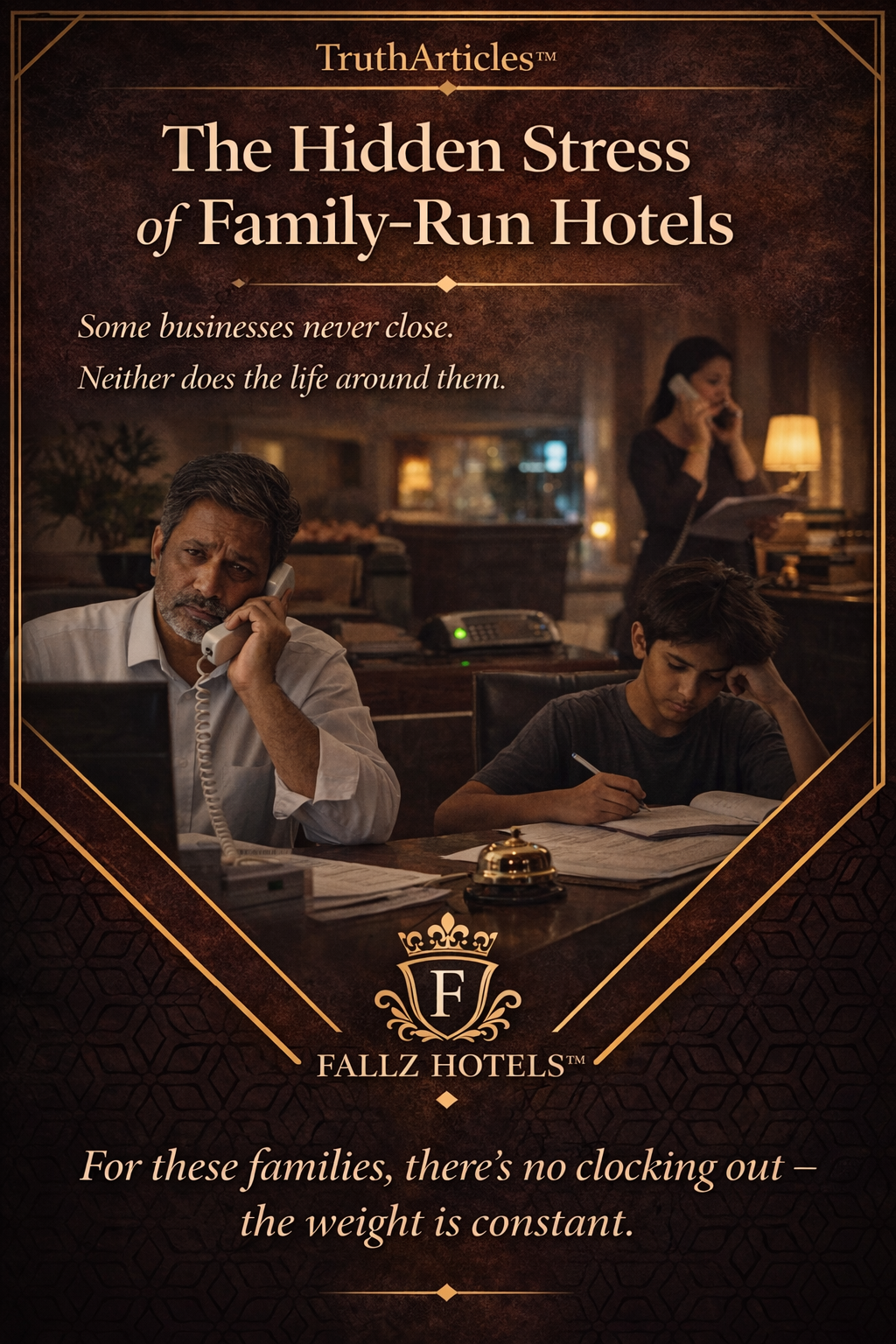
There is a version of hotel ownership most people see.
Guests checking in.
Clean rooms.
A steady flow of business.
A family behind the front desk.
From the outside, it can look stable.
Predictable, even.
But inside many family-run hotels—especially those built from the ground up—
the lines between business and life do not simply blur.
Over time…
they disappear.
For many owners, this business did not begin with some carefully designed long-term plan.
It started with opportunity.
And risk.
Often:
• A first property
• A loan that felt heavy from the beginning
• Long hours that had to be accepted—not negotiated
• A willingness to do whatever was necessary to survive
There was no perfect work-life balance to figure out.
There was simply one priority:
Make it work.
And for many Indian hotel owners,
that meant doing whatever was required—
for however long it took.
Hotels do not close.
And when the business is family-run,
there is often no real backup system.
A guest arrives late.
You respond.
A room issue appears.
You handle it.
Someone calls in sick.
You fill the gap.
Over time, something subtle changes.
You are no longer running the hotel.
The hotel begins running your schedule.
Quietly.
Consistently.
Without asking permission.
What rarely gets discussed is how deeply this affects the household itself.
Not through dramatic moments.
But through constant interruptions.
Small ones.
Repeated ones.
Things like:
• Dinners paused halfway through
• Weekends that never fully feel like weekends
• Family plans interrupted by operational problems
• Children learning early that the business often comes first
Not because parents want it that way.
But because the business quietly demands it.
And over time…
everyone adapts.
Even when they do not realize they are adapting.
For many immigrant hotel owners, there is another pressure underneath it all.
Responsibility.
Not only to the business—
but beyond it.
Responsibility to:
• Family back home
• Financial obligations that extend beyond the property
• Expectations tied to taking a risk so few others would take
Failure rarely felt like an option.
The pressure was not temporary.
It became part of daily life.
Part of the environment.
Something quietly carried for years.
The second generation does not simply grow up around hospitality.
They witness something deeper.
They see:
• How often parents are interrupted
• How difficult it is to fully disconnect
• How much responsibility quietly sits on their shoulders
• How often personal time becomes business time
They see the effort.
But they also see the cost.
And that reality shapes how they think about their own future.
Sometimes quietly.
Sometimes more directly than parents realize.
Most owners would never describe it that way.
Instead, they tend to say things like:
“We are used to it.”
“This is just how it is.”
“It worked for us.”
And all of those things are true.
But underneath those words…
there is often another feeling.
One that sounds more like:
→ This took more than we expected
→ And we carried it longer than we imagined
Not regret.
Just honesty.
The pressure of ownership is rarely one big event.
It is accumulation.
Years of:
• Interrupted routines
• Constant availability
• Decisions that cannot wait until tomorrow
• Feeling responsible at all hours
Individually, none of it seems overwhelming.
Together…
it slowly becomes a lifestyle.
One that can feel difficult to step away from.
Even after decades.
Guest (late night):
“Sorry, we did not book. Do you have anything available?”
Owner (already exhausted):
“Yes, of course.”
(Later)
Child (from nearby):
“Are you coming to eat?”
Owner:
“I will come in a bit.”
That “bit”…
has a way of stretching into years.
At some point, many owners notice the conversation quietly shift.
Not suddenly.
Gradually.
From:
• “How do we keep growing this?”
To:
• “How long do we want to keep living like this?”
And eventually:
• “What might another path forward look like?”
That shift happens quietly in more families than people realize.
Family-run hotels create something meaningful.
Stability.
Opportunity.
A future that may not have existed otherwise.
But they ask for something in return.
Time.
Energy.
Presence.
And over decades…
that exchange quietly becomes part of the story.
Not always visible.
But deeply felt.
And when that realization settles in—
the conversation about what comes next
often stops feeling rushed.
And starts feeling necessary.

Many hotel owners begin thinking about the next chapter years before they ever make a decision.
Sometimes the first step is simply understanding what options may exist — quietly and without pressure.
Private hotel conversations.
Before anything becomes public.
Oakville, Ontario, Canada
Private conversations. No public listings.
Your information is handled with care — always.