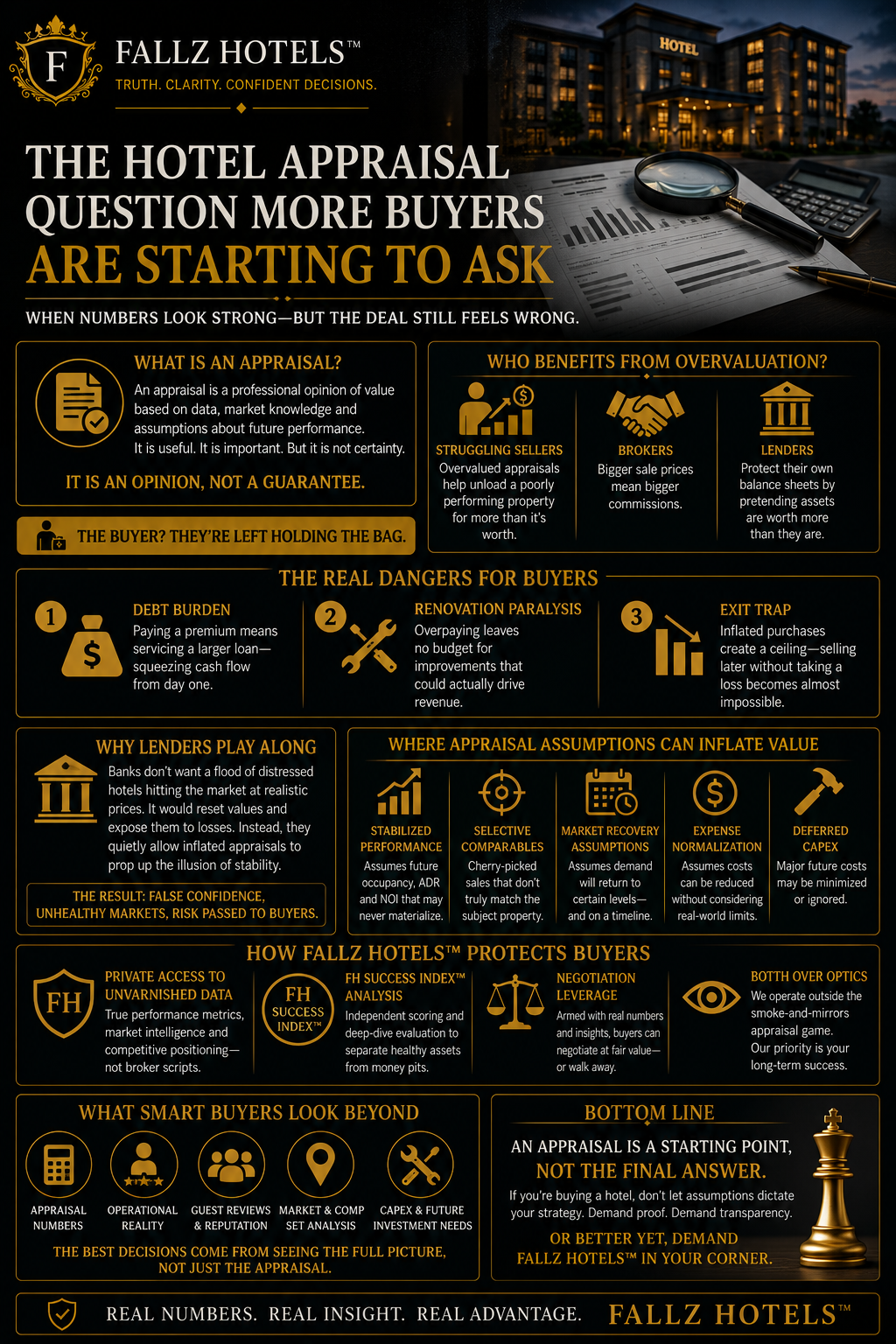
A hotel appraisal may look objective on paper. But experienced buyers increasingly understand something important: an appraisal is still an opinion built on assumptions. And assumptions deserve scrutiny.

Hotel appraisals carry weight.
Banks rely on them.
Buyers review them.
Sellers reference them.
Brokers discuss them.
And for many hotel transactions—
they quietly shape expectations before negotiations even begin.
Which makes them important.
Very important.
But experienced buyers increasingly understand something else:
A professional opinion.
A useful opinion.
But still—
an opinion built on assumptions.
And assumptions deserve scrutiny.
Especially in hospitality.
To be fair—
appraisals matter for good reason.
Strong appraisers bring:
• market knowledge
• valuation methodology
• operating context
• financing insight
• comparable analysis
Their role is not guesswork.
Their role is to estimate value using available information and accepted approaches.
That deserves respect.
Most appraisals are completed thoughtfully and professionally.
But hotel valuation is rarely simple.
Because hotels are not ordinary real estate.
They are operating businesses.
And businesses change.
Sometimes quickly.
This is where sophisticated buyers begin asking harder questions.
Because hotel valuations often rely on assumptions such as:
• future performance
• stabilized occupancy
• ADR growth expectations
• expense normalization
• market recovery timing
• competitive positioning
• future management effectiveness
None of those things are guaranteed.
They are forecasts.
Informed forecasts—
but forecasts nonetheless.
And when assumptions become optimistic—
valuations may begin drifting from operating reality.
Quietly.
One common tension?
The difference between:
and
Many appraisals evaluate a property based on stabilized performance expectations.
Meaning:
What the hotel should reasonably achieve under stronger operations or normalized conditions.
That can be useful.
Very useful.
Especially for turnaround opportunities.
But buyers eventually ask:
That distinction matters.
Especially when debt service begins immediately.
Another area sophisticated buyers watch carefully?
Comparables.
Because not all hotels are truly comparable.
A hotel may appear similar on paper—
but differ dramatically in:
• brand strength
• location quality
• deferred maintenance
• guest reputation
• management quality
• local demand drivers
• renovation needs
Even timing matters.
A hotel sold during unusually strong market conditions may not reflect today’s environment.
Especially after hospitality volatility in recent years.
Strong buyers know:
This part is interesting.
Sometimes a buyer reviews an appraisal and thinks:
“The numbers look fine…”
But something still feels off.
The guest reviews.
The building condition.
The staffing issues.
The market softness.
The capital needs.
The local competition.
That instinct deserves attention.
Because sophisticated investors eventually learn:
The strongest decisions usually consider both.
Another quiet reality?
Lenders and buyers are solving different problems.
A lender may focus on:
Risk protection.
Collateral support.
Loan structure.
Financial coverage.
A buyer?
They are thinking longer-term:
Cash flow.
Reinvestment.
Future exit value.
Operational upside.
Long-term sustainability.
Those lenses do not always align perfectly.
And understanding that distinction matters.
Strong hotel buyers rarely rely on one lens alone.
They examine:
• appraisal assumptions
• market performance trends
• guest sentiment
• comp-set positioning
• CapEx exposure
• operational weaknesses
• brand risk
• staffing realities
• local market demand
Increasingly—
many also want broader operating intelligence.
Not simply:
But:
That question often changes everything.
This is partly why broader performance analysis matters.
At FALLZ HOTELS™, we increasingly believe buyers need more than valuation.
They need perspective.
A stronger understanding of:
• operational health
• guest positioning
• competitive strength
• future risk
• growth potential
Because buying well is not only about price.
It is about clarity.
Buyer:
“The appraisal supports the asking price.”
(Pause)
Advisor:
“Do you believe the operations support it?”
(Long pause)
That question—
quietly—
changes how sophisticated investors think.
Hotel appraisals matter.
Good appraisers matter.
Professional valuation absolutely matters.
But experienced buyers eventually understand something important:
Because great hotel investing rarely comes from trusting one document.
It comes from asking better questions.
And in hospitality—
the smartest buyers understand:
Many hotel owners begin thinking about the next chapter years before they ever make a decision.
Sometimes the first step is simply understanding what options may exist — quietly and without pressure.
Private hotel conversations.
Before anything becomes public.
Oakville, Ontario, Canada
Private conversations. No public listings.
Your information is handled with care — always.