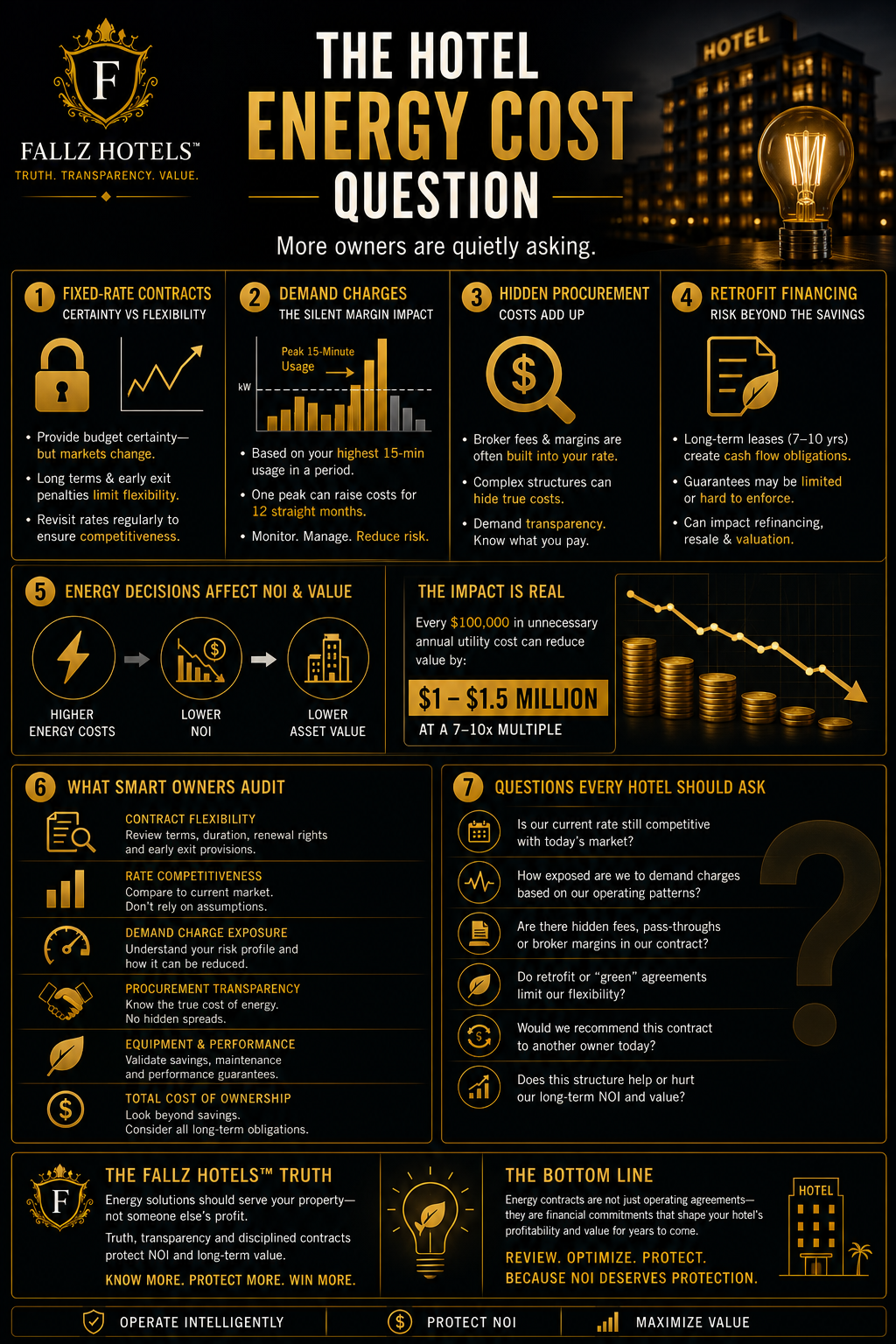
Energy is one of hospitality’s biggest controllable expenses. Yet many hotel owners discover something frustrating too late: decisions made to create stability can sometimes become long-term cost pressures. And in a business driven by margins, even small inefficiencies quietly matter.

Energy rarely gets the spotlight in hospitality.
Guests do not notice it.
Brands rarely advertise it.
Owners rarely discuss it publicly.
But quietly—
energy sits among a hotel’s largest controllable operating expenses.
HVAC.
Lighting.
Laundry.
Kitchen systems.
Water heating.
Guest room consumption.
Conference space.
Pool operations.
Seasonal demand.
In hospitality—
energy never really stops.
Which means:
Small cost assumptions can become very large financial realities over time.
And increasingly—
experienced hotel owners are beginning to ask a more nuanced question:
Because certainty and flexibility do not always age the same way.
In hospitality—
small margin shifts matter.
A lot.
Energy costs influence:
Operating profit.
Cash flow.
Cap rates.
Property valuation.
Investment returns.
And because hotels operate almost continuously—
cost structures compound quickly.
What feels manageable one year—
may feel very different several years later.
Especially when markets shift.
Which is partly why owners increasingly revisit decisions once considered “safe.”
Many hotels pursue fixed-rate energy agreements for good reason.
Predictability matters.
Budgeting matters.
Volatility protection matters.
No owner wants major energy surprises.
That logic makes sense.
And sometimes—
fixed structures perform extremely well.
But occasionally—
owners revisit contracts years later and quietly ask:
Because markets move.
Rates shift.
Consumption changes.
Operational needs evolve.
And long-term agreements occasionally outlast the assumptions that justified them.
The challenge?
Some structures are easier to enter than exit.
That reality deserves careful review.
Another quiet frustration?
Energy procurement can feel surprisingly opaque.
Brokers.
Suppliers.
Rate structures.
Pass-through language.
Market assumptions.
Forecasting.
Timing.
For many owners—
the process feels harder to fully understand than it probably should.
That does not automatically mean poor decisions were made.
But sophisticated operators increasingly ask:
Because long-term operating costs deserve clarity.
Especially when NOI is involved.
This is one many owners discover only after seeing unexpected bills.
Certain utility structures include demand-based charges—
meaning:
A short period of unusually high consumption may influence costs beyond that moment.
Peak HVAC usage.
Large banquet events.
Seasonal occupancy spikes.
Extreme weather.
Equipment overlap.
Again—
not necessarily unfair.
Infrastructure planning matters.
But many operators quietly admit:
And once understood—
many begin paying closer attention to operational timing and energy efficiency.
Another increasingly common area?
Energy-related upgrades.
LED programs.
HVAC modernization.
Solar integration.
Efficiency systems.
Smart controls.
Often—
these investments genuinely improve operations.
That deserves recognition.
But experienced owners increasingly ask harder questions before signing:
• What is the true ROI?
• How long is the obligation?
• Does flexibility remain?
• How will this affect refinancing?
• Does future ownership inherit restrictions?
Because occasionally—
solutions designed to reduce costs become more financially complex than expected.
Especially when long-term agreements are involved.
This part matters.
Because energy decisions do not only affect monthly expenses.
They affect:
And in hospitality—
NOI shapes value.
Even modest annual cost inefficiencies may influence long-term asset performance.
Which is why disciplined operators increasingly examine:
—not simply cost today.
Because today’s operating decisions often shape tomorrow’s valuation story.
Increasingly—
experienced operators are reviewing:
• contract flexibility
• procurement transparency
• utility structures
• demand charge exposure
• retrofit obligations
• equipment performance
• operational efficiency trends
Not because something is necessarily wrong.
Because scrutiny protects margins.
And margins protect value.
Owner:
“We locked this in years ago to create certainty.”
(Pause)
Advisor:
“Does it still serve the property today?”
(Long pause)
That question—
quietly—
changes many decisions.
Energy management is not exciting.
It is not glamorous.
Guests rarely notice it.
But experienced hotel owners eventually understand something important:
Because in hospitality—
protecting NOI is rarely about one big decision.
Many hotel owners begin thinking about the next chapter years before they ever make a decision.
Sometimes the first step is simply understanding what options may exist — quietly and without pressure.
Private hotel conversations.
Before anything becomes public.
Oakville, Ontario, Canada
Private conversations. No public listings.
Your information is handled with care — always.