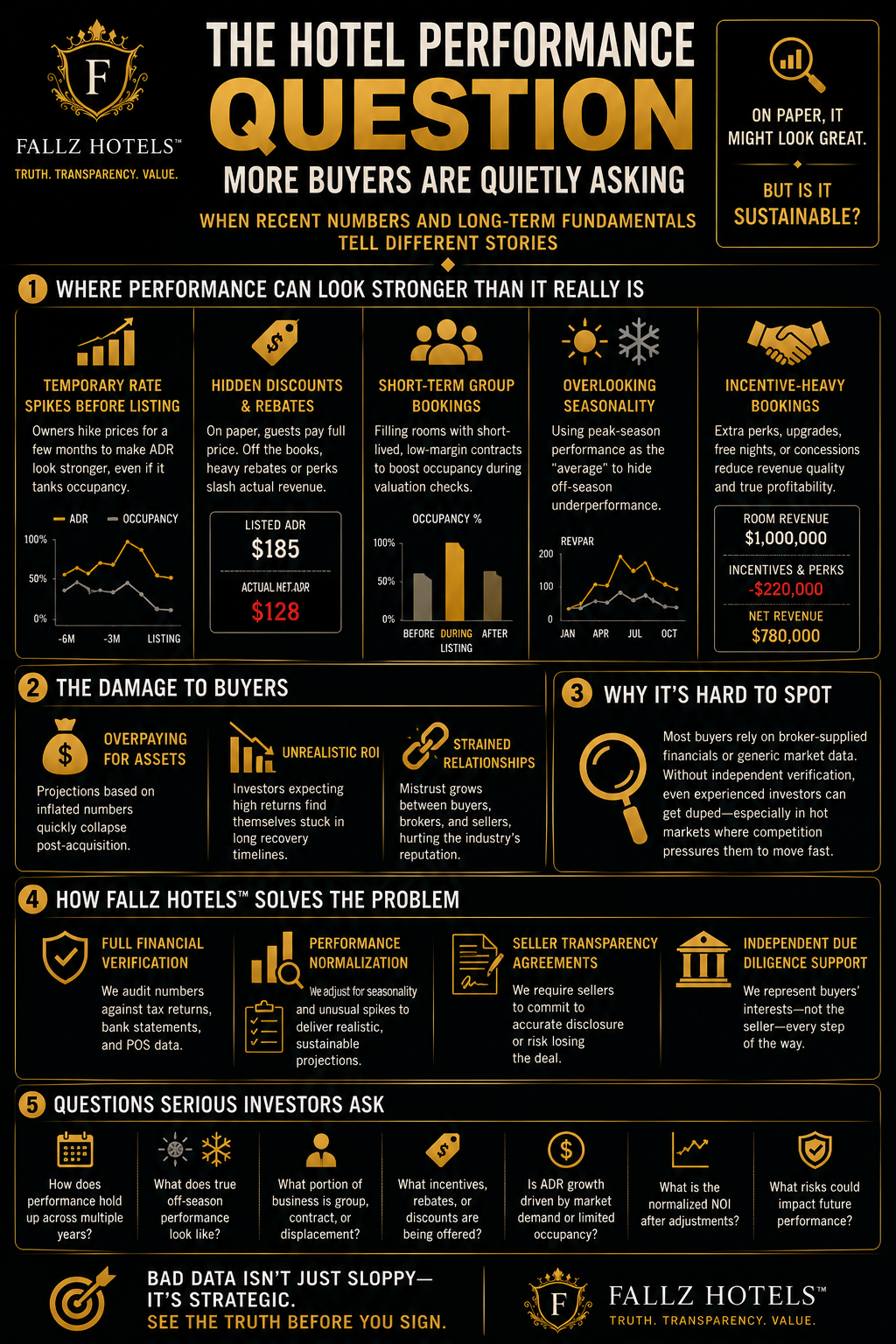
Strong ADR. Healthy occupancy. Positive trends. On paper, a hotel can look exceptionally healthy. But experienced buyers increasingly understand something important: not all performance tells the full story. And sometimes, recent numbers deserve deeper context before assumptions are made.

In hotel acquisitions—
numbers matter.
Deeply.
ADR.
Occupancy.
RevPAR.
NOI.
Margins.
Guest mix.
Forward bookings.
These numbers shape:
Valuation.
Lending.
Negotiation.
Buyer confidence.
And in many transactions—
they quietly shape expectations long before a deal closes.
Strong recent performance?
Confidence rises.
Weak performance?
Caution follows.
Simple.
At least—
on paper.
But increasingly—
experienced hotel buyers are asking a more sophisticated question:
Because in hospitality—
short-term performance and long-term strength do not always move together.
And understanding the difference matters.
A lot.
To be fair—
hotel performance data matters for good reason.
It tells a story.
Demand patterns.
Market health.
Pricing power.
Guest behavior.
Operational execution.
No serious investor ignores that.
Strong performance deserves recognition.
But sophisticated buyers eventually understand something important:
Not misleading stories.
Incomplete ones.
That distinction matters.
Because hotels are dynamic businesses.
Markets shift.
Demand changes.
Events distort patterns.
Weather matters.
Local economies matter.
Temporary momentum sometimes happens.
And temporary softness sometimes happens too.
Which is why experienced investors increasingly focus on:
—not simply performance visibility.
One area buyers increasingly examine?
ADR strength.
A hotel may show:
Improved pricing.
Recent growth.
Stronger margins.
Positive momentum.
That deserves attention.
But sophisticated buyers often ask:
Temporary compression?
Major events?
Short-term demand spikes?
Unique local circumstances?
Rate changes that reduced occupancy?
None of these are automatically concerns.
But context matters.
Because buyers eventually ask:
That question quietly changes valuation assumptions.
Another subtle distinction?
Occupancy quality.
Hotels occasionally experience short-term demand boosts:
Project crews.
Temporary contracts.
Event-related business.
Short-term groups.
Unexpected displacement demand.
Again—
nothing wrong with this.
Revenue matters.
But experienced buyers increasingly ask:
Because strong occupancy and strong fundamentals are not always identical.
And sophisticated underwriting recognizes that.
Hospitality has always been seasonal.
Which sounds obvious—
until numbers are presented without enough context.
Some hotels naturally experience:
Peak-season surges.
Holiday compression.
Summer strength.
Event-driven spikes.
Regional tourism cycles.
Which means:
Experienced investors increasingly normalize performance.
Not to diminish results.
To understand reality.
Because eventually—
buyers ask:
That question matters.
Especially when financing is involved.
This surprises newer investors.
Because not all revenue behaves equally.
Sophisticated buyers increasingly examine:
Guest mix.
Channel mix.
Rate quality.
Discounting trends.
Contract business.
Margin contribution.
In other words:
Because:
That distinction becomes important after closing.
When assumptions meet reality.
Many disappointing acquisitions share something in common:
The story looked stronger than the fundamentals.
Not because anyone acted improperly.
Because performance interpretation is complex.
Temporary strength gets mistaken for permanent momentum.
Strong months get treated as standard performance.
Exceptional periods quietly become expectations.
And eventually—
buyers discover:
That lesson can be expensive.
Increasingly—
experienced hotel investors examine:
• normalized ADR
• seasonality trends
• occupancy durability
• guest mix quality
• unusual demand spikes
• contract exposure
• operational consistency
• deferred CapEx
• market sustainability
Not because they distrust sellers.
Because disciplined underwriting matters.
And good acquisitions begin with better questions.
Buyer:
“The recent performance looks strong.”
(Pause)
Advisor:
“Do you think it reflects the market…”
(Long pause)
Advisor:
“…or the moment?”
That question—
quietly—
changes many investment decisions.
Hotel performance matters.
Strong operators deserve credit for strong results.
But experienced buyers eventually understand something important:
Because in hospitality—
Many hotel owners begin thinking about the next chapter years before they ever make a decision.
Sometimes the first step is simply understanding what options may exist — quietly and without pressure.
Private hotel conversations.
Before anything becomes public.
Oakville, Ontario, Canada
Private conversations. No public listings.
Your information is handled with care — always.