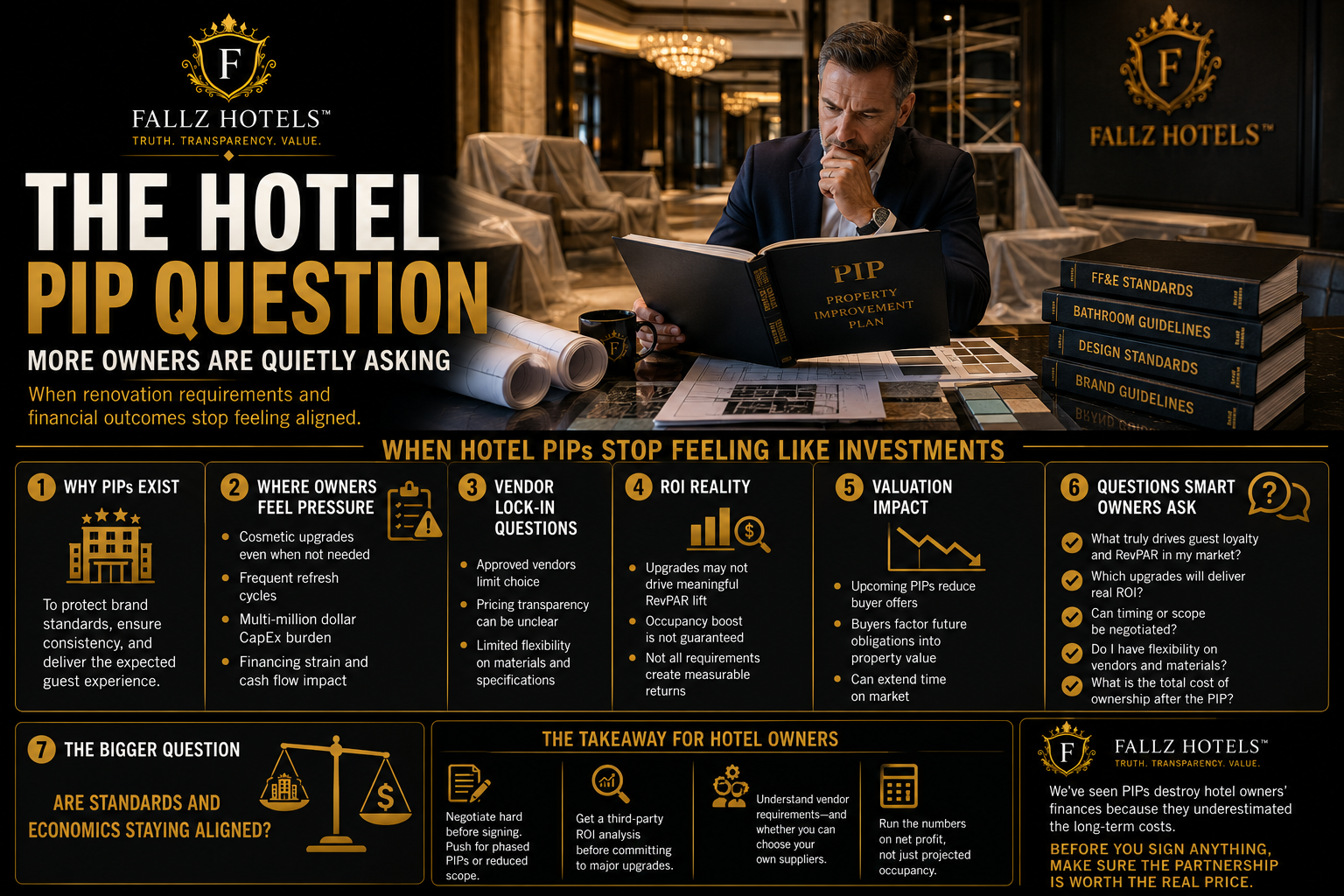
Most hotel owners understand the importance of brand standards. Consistency matters. Guest expectations matter. But increasingly, many owners are beginning to ask a harder question: Do all Property Improvement Plans (PIPs) create enough measurable value to justify the cost?

Every branded hotel owner knows the moment.
The agreement renewal approaches.
A review happens.
Then eventually—
it arrives.For many hotel owners—
the conversation starts with optimism.
A stronger flag.
Greater visibility.
Higher occupancy.
Loyalty-driven demand.
Brand recognition.
Distribution power.
Operational support.
The logic feels compelling.
And in many cases—
franchise partnerships genuinely create value.
That deserves acknowledgment.
But eventually—
many branded hotel owners encounter another reality of the relationship:
Property Improvement Plan.
And increasingly—
some owners are quietly asking a harder question:
Because while standards matter—
economics matter too.
And sometimes—
those two priorities stop feeling perfectly aligned.
To be fair—
PIPs exist for understandable reasons.
Brands are built on consistency.
Guests expect:
Modern rooms.
Updated finishes.
Reliable quality.
Recognizable design standards.
A consistent experience from market to market.
That consistency protects:
Guest trust.
Brand reputation.
Review performance.
Competitive positioning.
No serious owner disputes this.
Neglected hotels hurt everyone—
including ownership.
And many PIPs genuinely improve competitiveness.
That deserves recognition.
But—
there is also a quieter conversation happening behind closed doors.
This is where many owners begin asking harder questions.
Because PIPs are rarely small.
They can involve:
Guestroom refreshes.
Bathroom upgrades.
Furniture replacement.
Lighting redesign.
Lobby renovations.
Exterior updates.
Technology upgrades.
Signage changes.
Soft goods replacement.
Sometimes—
even relatively recent renovations still require updates to meet evolving standards.
Which raises a fair business question:
That distinction matters.
Especially when millions of dollars are involved.
Most experienced operators think practically.
They think in:
NOI.
ADR.
Occupancy.
RevPAR.
Cash flow.
Asset value.
Debt servicing.
Which means many naturally ask:
Sometimes—
absolutely.
A tired property often needs reinvestment.
Poor guest perception matters.
Competitive positioning matters.
But other times—
the relationship between spend and outcome feels harder to measure.
Owners occasionally wonder:
• Will guests meaningfully notice?
• Will ADR improve enough to justify spend?
• Does this market support higher rates?
• Is occupancy already stable?
• Are there higher-priority investments?
Because eventually—
owners stop asking:
And begin asking:
That shift matters.
Another quieter frustration owners sometimes raise?
Vendor flexibility.
Many branded systems recommend—or require—approved suppliers.
Again—
there are understandable reasons:
Consistency.
Quality control.
Installation familiarity.
Brand alignment.
That logic makes sense.
But owners occasionally ask:
Questions increasingly raised include:
• Are prices competitive?
• Is flexibility available?
• Could equivalent quality exist elsewhere?
• Are there alternative suppliers?
• Is customization possible based on market needs?
These are reasonable business questions.
Especially when CapEx becomes substantial.
This part matters.
Because PIPs do not happen in theory.
They happen in cash flow.
Loans.
Debt.
Refinancing.
Capital reserves.
Interest costs.
Timing pressure.
And in slower-performing markets—
the financial lift from branding improvements may feel less immediate than expected.
Some owners quietly admit:
That reality deserves acknowledgment.
Because timing matters almost as much as scope.
Experienced hotel buyers think about PIPs too.
A lot.
Because looming renovation obligations influence:
Purchase pricing.
Negotiation leverage.
Future CapEx planning.
Investment returns.
Valuation assumptions.
Sophisticated buyers increasingly ask:
Because a major upcoming PIP can materially affect what buyers are willing to pay.
Sometimes significantly.
Meaning—
today’s renovation requirement may influence tomorrow’s exit value.
That deserves serious thought.
Increasingly—
experienced hotel owners ask smarter questions before committing:
• Which upgrades truly affect guest satisfaction?
• Which improvements drive ADR?
• What genuinely impacts RevPAR?
• Can implementation be phased?
• Is timing negotiable?
• What flexibility exists with vendors?
• What is the projected return on invested capital?
Not to avoid investment.
To prioritize investment intelligently.
Because experienced operators understand:
Owner:
“We understand the standards…”
(Pause)
Owner:
“…we’re just trying to understand what actually creates value.”
That question—
quietly—
captures where many owners are today.
Strong brands matter.
Guest trust matters.
Consistency matters.
Good renovations matter.
But experienced hotel owners eventually understand something important:
Because the strongest hotels rarely invest blindly.
The PIP.
Property Improvement Plan.
For some owners—
it feels manageable.
For others—
it feels overwhelming.
And increasingly—
many hotel owners are quietly beginning to ask a harder question:
Because while brand consistency matters—
investment returns matter too.
And sometimes—
those two priorities stop feeling perfectly aligned.
To be fair—
PIPs exist for good reason.
Brands are built on consistency.
Guests expect:
Updated spaces.
Reliable quality.
Modern design.
Clean finishes.
Brand familiarity.
That consistency protects reputation.
And in many cases—
strong standards absolutely matter.
A neglected property hurts:
Guest trust.
Review scores.
Brand perception.
Future demand.
No serious owner disputes that.
Many PIPs genuinely improve competitiveness.
That deserves acknowledgment.
But—
there is also a more nuanced conversation emerging.
This is where tension begins.
Some upgrades feel obvious.
Outdated rooms?
Modernize them.
Worn finishes?
Refresh them.
Poor guest experience?
Improve it.
Most owners understand that.
The harder conversation emerges when requirements feel less clearly connected to performance.
Examples owners sometimes quietly mention:
Replacing still-functional finishes.
Furniture refreshes on rigid timelines.
Cosmetic redesigns with unclear guest impact.
New standards that feel trend-driven more than market-driven.
Which raises a fair question:
That distinction matters.
Especially when millions of dollars are involved.
Hospitality is practical.
Owners think in:
NOI.
ADR.
Occupancy.
Guest satisfaction.
Long-term asset value.
Which means—
many naturally ask:
Sometimes?
Yes.
Absolutely.
Other times—
the financial relationship feels harder to see.
Guests may barely notice.
Review scores barely shift.
ADR lift feels modest.
Demand patterns stay largely unchanged.
Meanwhile—
CapEx costs remain very real.
That tension deserves honest discussion.
Another topic owners quietly raise?
Approved vendors.
Many branded systems require specific suppliers.
Again—
there are valid reasons.
Consistency.
Quality control.
Brand standards.
Installation reliability.
That logic makes sense.
But some owners occasionally wonder:
Because hotel owners often ask:
• Are pricing structures competitive?
• Could equivalent quality exist elsewhere?
• Are savings being fully passed through?
• How much flexibility actually exists?
These are reasonable business questions.
Especially when renovation budgets become substantial.
This part is important.
Because PIPs are not theoretical.
They affect:
Cash flow.
Debt.
Financing.
Refinancing.
Operating flexibility.
Reserves.
And occasionally—
ownership stress.
Particularly in:
Higher-rate environments.
Soft demand periods.
Markets facing labour pressure.
Unexpected operating costs.
For some hotels—
timing becomes as important as scope.
And owners increasingly ask:
That conversation is growing.
Quietly.
This often gets overlooked.
PIPs do not only affect current owners.
They influence:
Acquisition pricing.
Negotiation leverage.
Future CapEx planning.
Valuation assumptions.
Experienced buyers increasingly ask:
Because looming renovation requirements influence what buyers are willing to pay.
Sometimes significantly.
Meaning—
today’s required investment may also shape tomorrow’s exit.
That matters.
Increasingly—
experienced owners are asking smarter questions:
• Which upgrades directly affect guest satisfaction?
• Which changes improve ADR potential?
• What actually moves RevPAR?
• Where does ROI feel measurable?
• Can implementation timing improve outcomes?
• How do other owners approach similar requirements?
Not to avoid investment.
To prioritize investment intelligently.
Because smart operators understand:
Owner:
“We understand the brand standards…”
(Pause)
Owner:
“…we’re just trying to understand what actually creates value.”
That question—
quietly—
captures the conversation many owners are having.
Strong brands matter.
Consistency matters.
Guest trust matters.
Good renovations matter.
But experienced hotel owners eventually understand something important:
Because the strongest hotels rarely invest blindly.
Many hotel owners begin thinking about the next chapter years before they ever make a decision.
Sometimes the first step is simply understanding what options may exist — quietly and without pressure.
Private hotel conversations.
Before anything becomes public.
Oakville, Ontario, Canada
Private conversations. No public listings.
Your information is handled with care — always.