Most hotel owners watch occupancy, payroll, ADR, and guest reviews closely. But some of the largest profit leaks happen somewhere quieter: purchasing decisions that slowly become expensive through habit, comfort, and reduced visibility.

Most hotel owners know where to look when profitability tightens.
Occupancy.
ADR.
Payroll.
Labour costs.
Guest sentiment.
Energy expenses.
The usual suspects.
But sometimes—
the pressure starts somewhere quieter.
Somewhere harder to spot.
Not in the rooms.
Not at the front desk.
Not in guest reviews.
Sometimes—
it starts in purchasing.
And over time—
small decisions quietly become expensive habits.
This part matters.
Strong vendor relationships can be incredibly valuable.
Trusted suppliers create consistency.
Reliability.
Operational speed.
Better service recovery.
And in hospitality—
reliability matters.
A lot.
The right vendor can make operations smoother and stronger.
That deserves acknowledgment.
But occasionally—
something shifts.
The relationship becomes comfortable.
Very comfortable.
And when comfort grows—
competitive discipline sometimes fades.
Quietly.
Most procurement problems do not begin dramatically.
Nobody wakes up trying to overspend.
Usually—
it happens slowly.
A supplier who has “always handled it.”
A contract nobody revisits.
Pricing increases accepted without comparison.
Renewals signed because:
“They know our property.”
“Switching feels difficult.”
“It is easier this way.”
Understandable?
Absolutely.
But sometimes—
comfort quietly becomes expensive.
Especially over years.
In many hotels—
owners are not deeply involved in day-to-day purchasing.
Nor should they need to be.
Operations teams move quickly.
Department heads manage vendors.
Management companies handle approvals.
Procurement decisions happen constantly.
That system works—
until visibility weakens.
Because occasionally—
ownership begins asking:
Not because anyone acted poorly.
Because assumptions quietly replaced scrutiny.
That distinction matters.
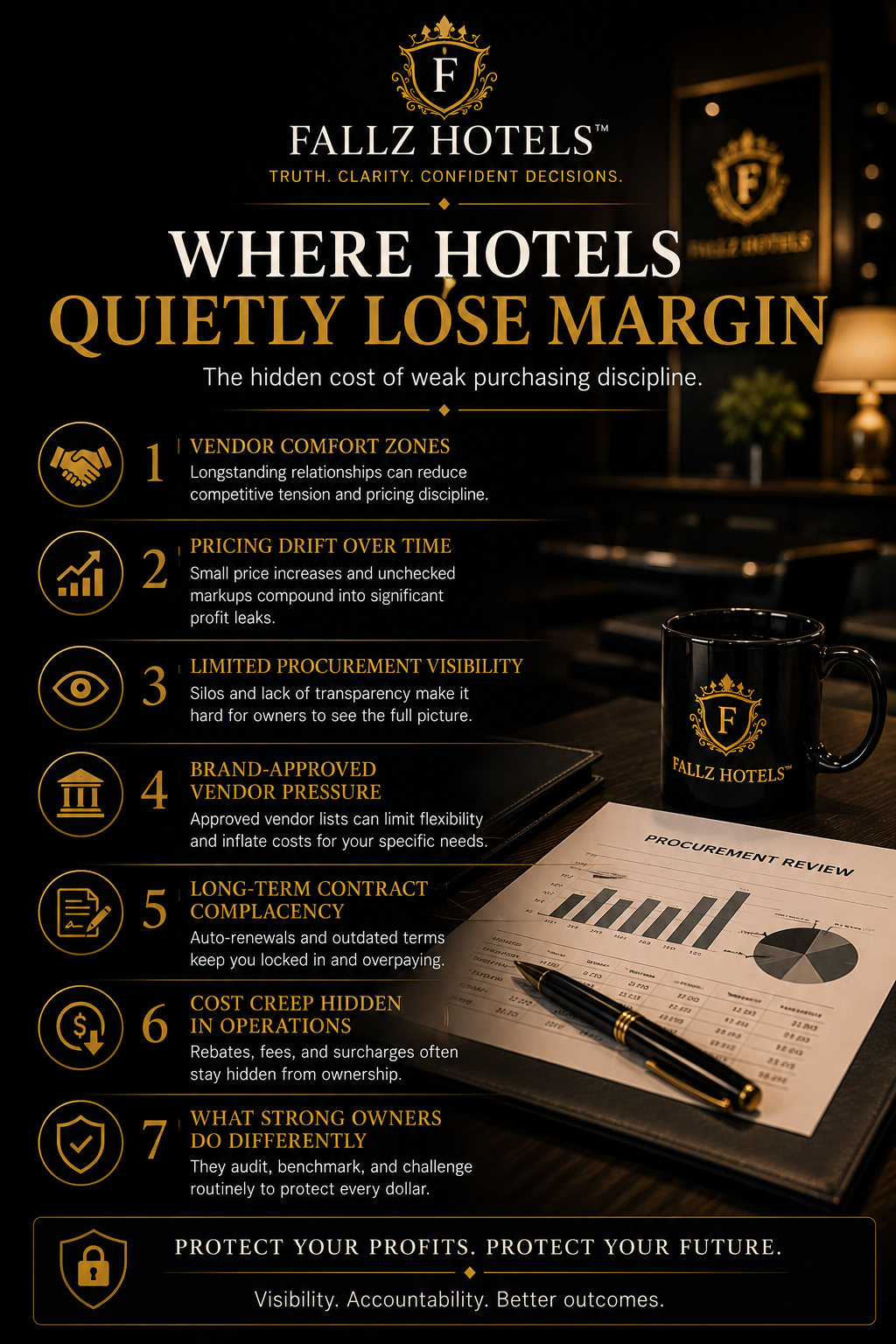
This is where profitability quietly leaks.
Long-standing relationships sometimes reduce:
• bid comparisons
• pricing reviews
• competitive quoting
• operational challenge
• contract renegotiation discipline
Not intentionally.
Naturally.
Because familiarity feels efficient.
But over time—
small inefficiencies compound.
A slightly inflated service agreement.
A supplier never challenged.
A purchasing habit no one revisits.
Across dozens of categories—
those small differences become meaningful.
Especially in hotels operating on tighter margins.
This part gets interesting.
Some hotels also navigate approved vendor ecosystems.
Brands often recommend—or require—certain suppliers to maintain consistency.
Sometimes that works well.
Sometimes it creates operational simplicity.
But owners occasionally wonder:
Because what works perfectly for one hotel—
may not always make sense for another.
Especially across:
• independent vs branded hotels
• urban vs resort properties
• luxury vs limited-service assets
• different labour realities
That tension deserves honest evaluation.
The issue is rarely one major mistake.
Usually—
it is gradual.
Quiet.
Difficult to notice.
Cost creep.
Vendor comfort.
Reduced visibility.
Fewer questions.
And eventually—
owners feel something strange:
Sometimes—
the answer is operational leakage hiding in plain sight.
Interestingly—
strong operators are becoming more disciplined here.
Not distrustful.
Disciplined.
They ask:
• When was this contract last benchmarked?
• Have we competitively priced this recently?
• Are incentives aligned with ownership goals?
• Are we choosing vendors based on value—or habit?
• Where are margins quietly slipping?
Some bring in:
• operational audits
• procurement reviews
• third-party cost benchmarking
• fresh vendor bidding cycles
Not reactively.
Thoughtfully.
Because stronger margins rarely come from one dramatic move.
They often come from many smaller decisions made better.
Owner:
“I do not understand. Revenue improved.”
Advisor:
“Margins?”
Owner:
“Still tight.”
(Pause)
Advisor:
“Then it may be time to follow the money more closely.”
That realization—
quietly—
changes how many owners see operations.
Most profitability problems are not dramatic.
They are gradual.
Quiet.
Hidden inside routines no one questions anymore.
Because hotels rarely lose money from one catastrophic decision.
More often—
they lose it slowly.
Through habits.
Comfort.
Assumptions.
And purchasing decisions nobody revisited for years.
The strongest operators eventually understand something important:
Because protecting margin quietly protects everything else.
Many hotel owners begin thinking about the next chapter years before they ever make a decision.
Sometimes the first step is simply understanding what options may exist — quietly and without pressure.
Private hotel conversations.
Before anything becomes public.
Oakville, Ontario, Canada
Private conversations. No public listings.
Your information is handled with care — always.