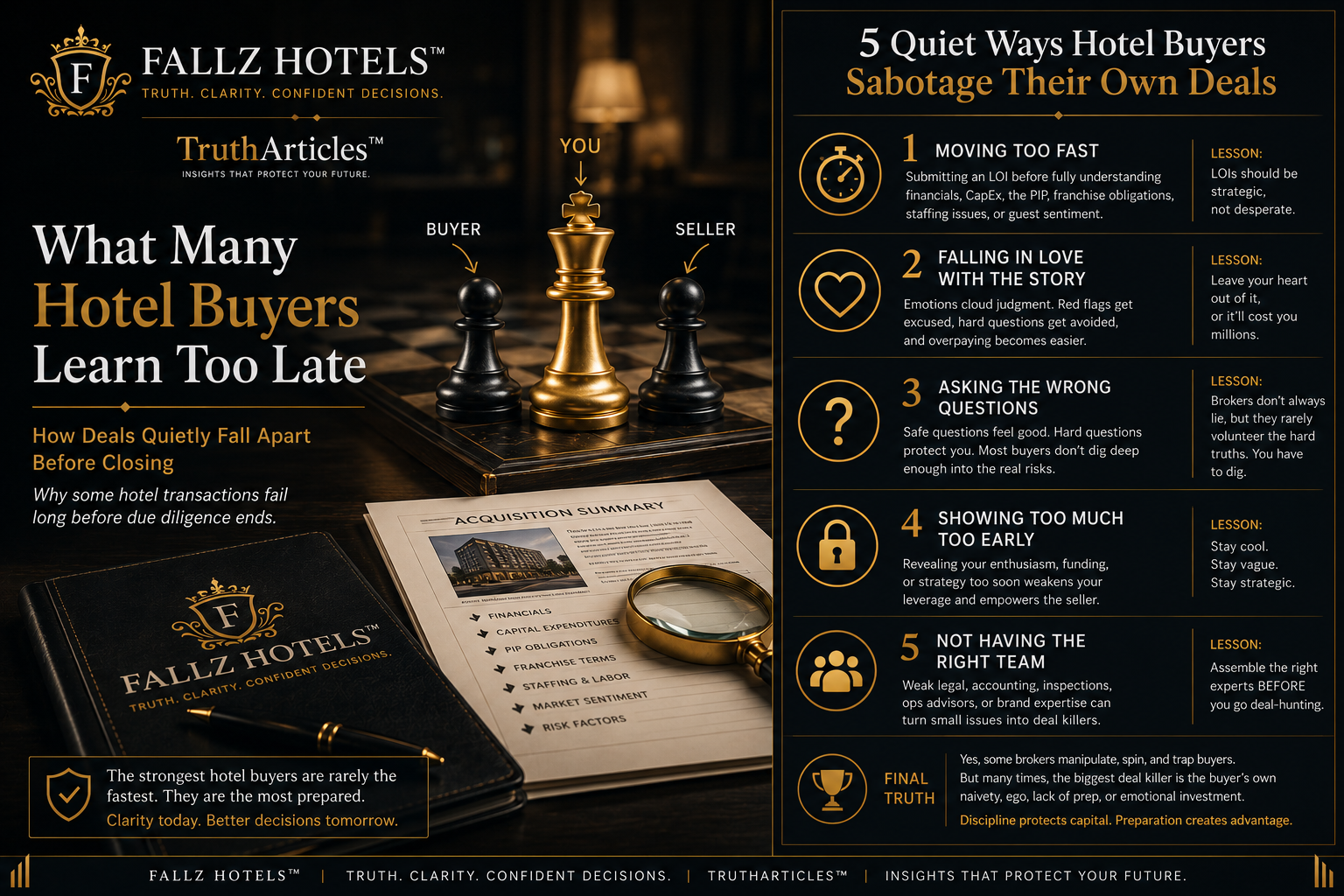
Not every failed hotel deal is caused by a broker, seller, or market shift. Sometimes, the biggest risks come from buyer psychology, rushed decisions, emotional attachment, or weak preparation. Here are the quiet ways hotel buyers unintentionally sabotage deals—and what stronger buyers do differently.

Hotel deals rarely collapse in one dramatic moment.
Most do not fail because of a single bad conversation.
Or one obvious mistake.
More often—
they quietly begin falling apart much earlier.
A rushed decision.
An emotional attachment.
A missed question.
A false sense of urgency.
Sometimes, the deal still closes.
But the problems show up later.
And by then—
the consequences can become expensive.
Because while hotel buyers often blame brokers, sellers, financing, or market timing…
many failed acquisitions quietly begin with something harder to admit:
The buyer was not as prepared as they thought.
Even sophisticated buyers can become emotional.
Especially in hospitality.
Hotels are different from many other assets.
They feel tangible.
Visible.
Prestigious.
Buyers walk the property.
Picture renovations.
Imagine repositioning.
Visualize growth.
And quietly—
emotion enters the room.
Especially when inventory feels limited.
Or the opportunity appears unique.
Suddenly, buyers begin thinking:
“We cannot lose this one.”
That feeling creates something dangerous:
Urgency disguised as conviction.
And those two things are not the same.
This happens more than many people realize.
A buyer becomes excited.
A broker mentions strong interest.
Another group appears interested.
Momentum builds.
Suddenly, there is pressure to submit an LOI quickly.
To “secure the opportunity.”
But strong buyers understand something important:
An LOI should never come from excitement.
It should come from understanding.
Before serious movement happens, buyers should already be thinking about:
• Historical financial performance
• Capital expenditure requirements
• Deferred maintenance
• Franchise obligations or PIPs
• Labour realities
• Guest sentiment trends
• Market shifts happening beneath the surface
Because confidence without clarity often becomes regret later.
Moving quickly can feel strategic.
Sometimes—
it is simply rushed.
Hotels carry emotion.
Sometimes more than buyers realize.
A buyer may think:
“We stayed at this brand years ago.”
Or:
“This location has huge potential.”
Or:
“This feels like a legacy opportunity.”
And sometimes…
those instincts are partly right.
But emotion changes behavior.
Buyers stop pushing difficult questions.
Red flags become easier to rationalize.
Concerns get softened.
Optimism quietly replaces discipline.
Sophisticated buyers understand something difficult:
Liking the story does not replace understanding the business.
Sometimes the hotel you want most—
is the one requiring the hardest questions.
Many buyers ask questions.
Just not always the right ones.
Questions like:
“What was occupancy last year?”
Or:
“What improvements have been completed?”
Matter.
But stronger buyers ask differently.
They quietly ask:
• Why is the owner really selling?
• What operational challenges are hardest to solve here?
• What has quietly gotten worse over time?
• What assumptions am I making that may not hold after closing?
• What would frustrate me most 90 days after acquisition?
Not because someone is hiding something.
But because every hotel has realities.
And realities rarely appear perfectly inside marketing packages.
The best buyers learn to listen for what is not being said.
Excitement creates another problem:
Oversharing.
Sometimes buyers unintentionally reveal too much.
Comments like:
“We finally found the right property.”
“We have been searching for months.”
“Funding is already lined up.”
Can quietly weaken negotiating leverage.
Because the seller suddenly learns something important:
The buyer is emotionally invested.
And emotionally invested buyers often negotiate differently.
Calmer buyers tend to perform better.
Not cold.
Just measured.
Curious.
Patient.
Strategic.
Hotel deals are complex.
Far more complex than many first-time buyers expect.
And sometimes buyers spend millions acquiring an asset—
while trying to save thousands on expertise.
Weak legal support.
Inexperienced accountants.
No operational advisor.
No local inspector.
No hospitality specialist reviewing assumptions.
Then later—
buyers wonder why surprises appeared after closing.
Sophisticated buyers think differently.
They build strong teams early.
Because diligence is expensive.
But bad surprises are usually more expensive.
There is another mistake that rarely gets discussed honestly:
Ego.
Sometimes buyers quietly convince themselves:
“We see something others missed.”
Or:
“We know how to unlock value quickly.”
And sometimes…
they are right.
But confidence becomes dangerous when it stops inviting skepticism.
Strong buyers stay curious.
Even when excited.
Especially when excited.
Because confidence without humility can become expensive.
Fast.
Buyer:
“We do not want to lose this property.”
Advisor:
“Do you want the deal… or the right deal?”
(Pause)
That pause—
quietly—
changes outcomes more often than people realize.
Not every failed hotel deal is someone else’s fault.
And not every successful-looking acquisition becomes a successful investment.
The strongest hotel buyers are rarely the loudest.
Or the fastest.
They tend to be:
• Patient
• Curious
• Disciplined
• Emotionally controlled
• Willing to ask harder questions
Because hotel deals rarely fall apart all at once.
Most begin drifting off course quietly—
through small decisions that felt harmless at the time.
And the buyers who understand that early…
usually make better decisions later.
Many hotel owners begin thinking about the next chapter years before they ever make a decision.
Sometimes the first step is simply understanding what options may exist — quietly and without pressure.
Private hotel conversations.
Before anything becomes public.
Oakville, Ontario, Canada
Private conversations. No public listings.
Your information is handled with care — always.