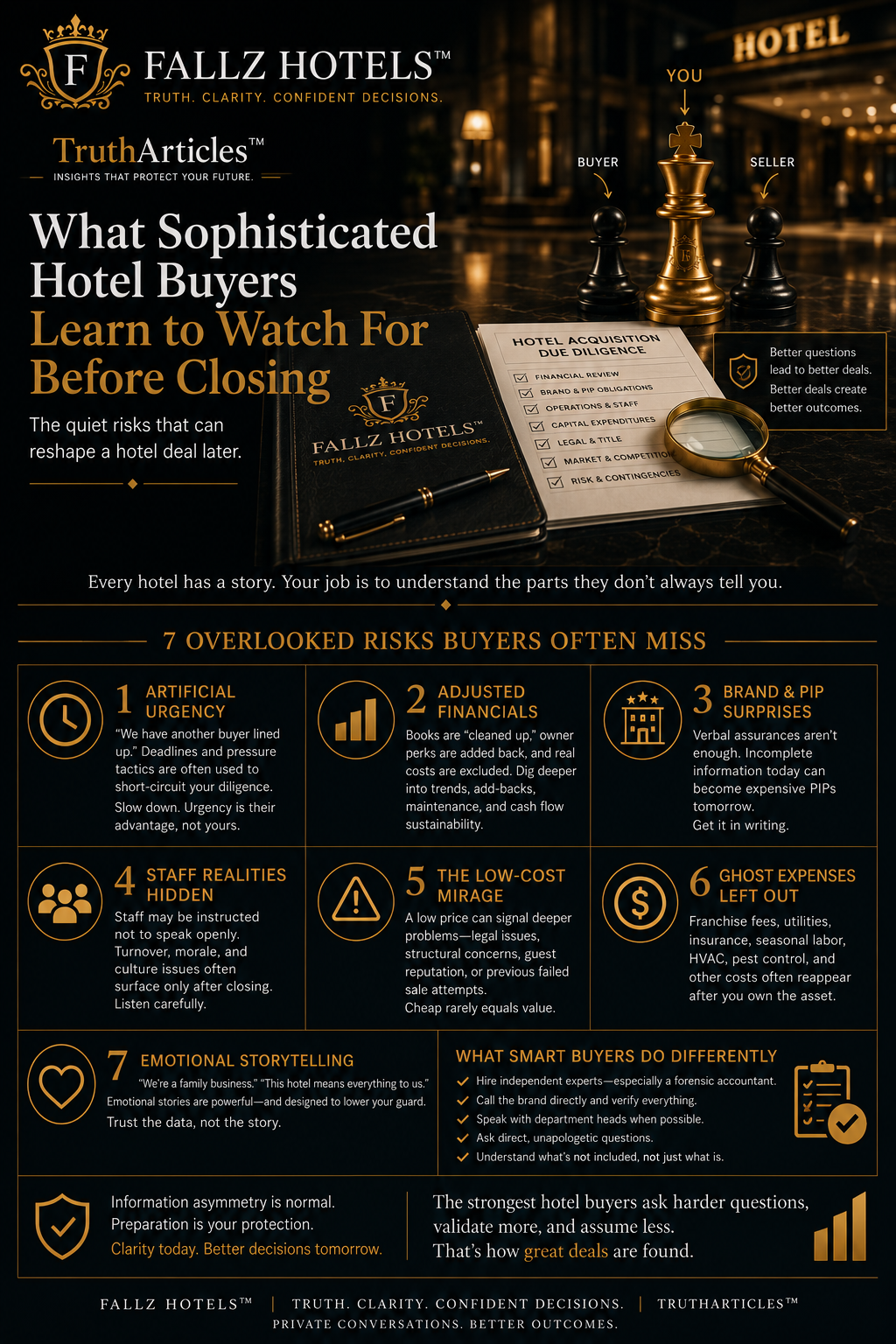
Strong hotel deals are rarely destroyed by one obvious mistake. More often, buyers underestimate hidden risks tied to financials, staffing, deferred maintenance, franchise obligations, or emotional decision-making. Here are the quiet realities sophisticated hotel buyers learn to watch for before closing.

Hotel deals rarely fall apart in dramatic fashion.
Most problems do not arrive with warning signs flashing.
They tend to appear quietly.
After closing.
When assumptions meet reality.
A financial trend that was misunderstood.
An operational issue that looked manageable on paper.
A renovation requirement that becomes larger than expected.
Or simply—
the realization that the property was far more complicated than first imagined.
Because in hotel transactions, what matters most is not only what gets shown.
It is what gets understood.
And sophisticated buyers eventually learn something important:
Strong acquisitions are not built on excitement.
They are built on better questions.
Hotels are emotional assets.
Unlike many commercial properties, buyers can physically experience them.
They walk the lobby.
See the guest rooms.
Imagine renovations.
Visualize growth.
Sometimes even picture legacy.
And quietly—
emotion begins influencing judgment.
Especially when inventory feels limited.
Or the opportunity appears unique.
Suddenly, thoughts become:
“We do not want to lose this property.”
That feeling is understandable.
But sophisticated buyers learn to pause here.
Because urgency and conviction are not the same thing.
Many hotel buyers eventually encounter pressure.
Sometimes directly.
Sometimes subtly.
Comments like:
“There is another buyer circling.”
“We expect LOIs quickly.”
“This opportunity may not last.”
And sometimes—
those things are completely true.
But strong buyers understand something important:
Urgency should never replace diligence.
The best hotel acquisitions are rarely won by moving the fastest.
They are won by understanding risk more clearly.
Because rushing into uncertainty rarely becomes a strategic advantage.
Financial packages matter.
But experienced buyers understand:
Financials are a starting point—
not the conclusion.
Sometimes numbers include reasonable add-backs.
Sometimes they reflect optimistic assumptions.
Sometimes costs quietly disappear.
Deferred maintenance.
Labour realities.
Seasonal volatility.
Insurance increases.
Capital expenditures waiting beneath the surface.
Sophisticated buyers do not assume deception.
But they also do not assume completeness.
They verify.
Carefully.
Because the real question is not:
“What does this property earn?”
It is:
“What would this property realistically earn under my ownership?”
That distinction changes outcomes.
Few things reshape hotel economics faster than unexpected franchise requirements.
Sometimes buyers hear:
“No major PIP expected.”
Or:
“The brand relationship is strong.”
And often—
that may be true.
But sophisticated buyers avoid assumptions.
They seek clarity directly.
Because renovation obligations can materially alter returns.
A manageable acquisition suddenly feels very different when major upgrades surface later.
The strongest buyers verify early.
Not after emotion enters the deal.
Hotels are people businesses.
And staffing realities matter more than many buyers initially realize.
Turnover.
Culture.
Management stability.
Department leadership.
Staff morale.
None of these fully appear inside financial packages.
Some operational strengths are invisible.
Some operational weaknesses are too.
Strong buyers learn to ask:
• What keeps this operation running smoothly?
• What problems quietly exist beneath the surface?
• What becomes harder after ownership changes?
Because sometimes the biggest asset is people.
And sometimes—
the biggest risk is losing them.
Every buyer loves discovering value.
But sophisticated buyers eventually learn something difficult:
Low pricing deserves deeper curiosity.
Sometimes opportunity is real.
Other times—
pricing reflects hidden friction.
Deferred CapEx.
Market positioning challenges.
Guest reputation issues.
Neighbourhood shifts.
Operational inefficiencies.
Or previous failed attempts to transition ownership.
Cheap does not automatically mean undervalued.
Sometimes—
it simply means harder.
Not every cost appears obvious early.
And small omissions become meaningful later.
Things like:
• Franchise fees
• Seasonal wage fluctuations
• Utility volatility
• HVAC servicing
• Pest control contracts
• Insurance increases
• Deferred maintenance cycles
Individually—
none feel overwhelming.
Together—
they materially affect performance.
Strong buyers think in full operating realities.
Not just acquisition excitement.
This may be the quietest risk of all.
Hotels carry stories.
Family ownership.
History.
Legacy.
A beautiful location.
A compelling narrative.
And sometimes—
those stories matter.
But sophisticated buyers learn something important:
Stories deserve respect.
Numbers deserve discipline.
Because once emotion outweighs diligence—
risk quietly increases.
The strongest buyers do not stop caring.
They simply stay objective while caring.
Buyer:
“We really do not want to lose this opportunity.”
Advisor:
“Do you want the hotel… or the right hotel?”
(Pause)
That pause—
quietly changes decisions more than people realize.
Not every seller is hiding something.
And not every hotel deal contains major surprises.
But sophisticated buyers understand this:
The strongest acquisitions rarely happen through excitement alone.
They happen through:
• Better preparation
• Better questions
• Better verification
• Better patience
Because hotel deals do not usually go wrong all at once.
Most drift quietly off course—
through assumptions left unchallenged.
And the buyers who learn to recognize that early…
usually make stronger decisions later.
Many hotel owners begin thinking about the next chapter years before they ever make a decision.
Sometimes the first step is simply understanding what options may exist — quietly and without pressure.
Private hotel conversations.
Before anything becomes public.
Oakville, Ontario, Canada
Private conversations. No public listings.
Your information is handled with care — always.