Most hotel brands want struggling properties to improve. But across hospitality, a difficult question is quietly emerging: At what point does keeping a weak hotel alive start hurting the rest of the market—and the brand itself?
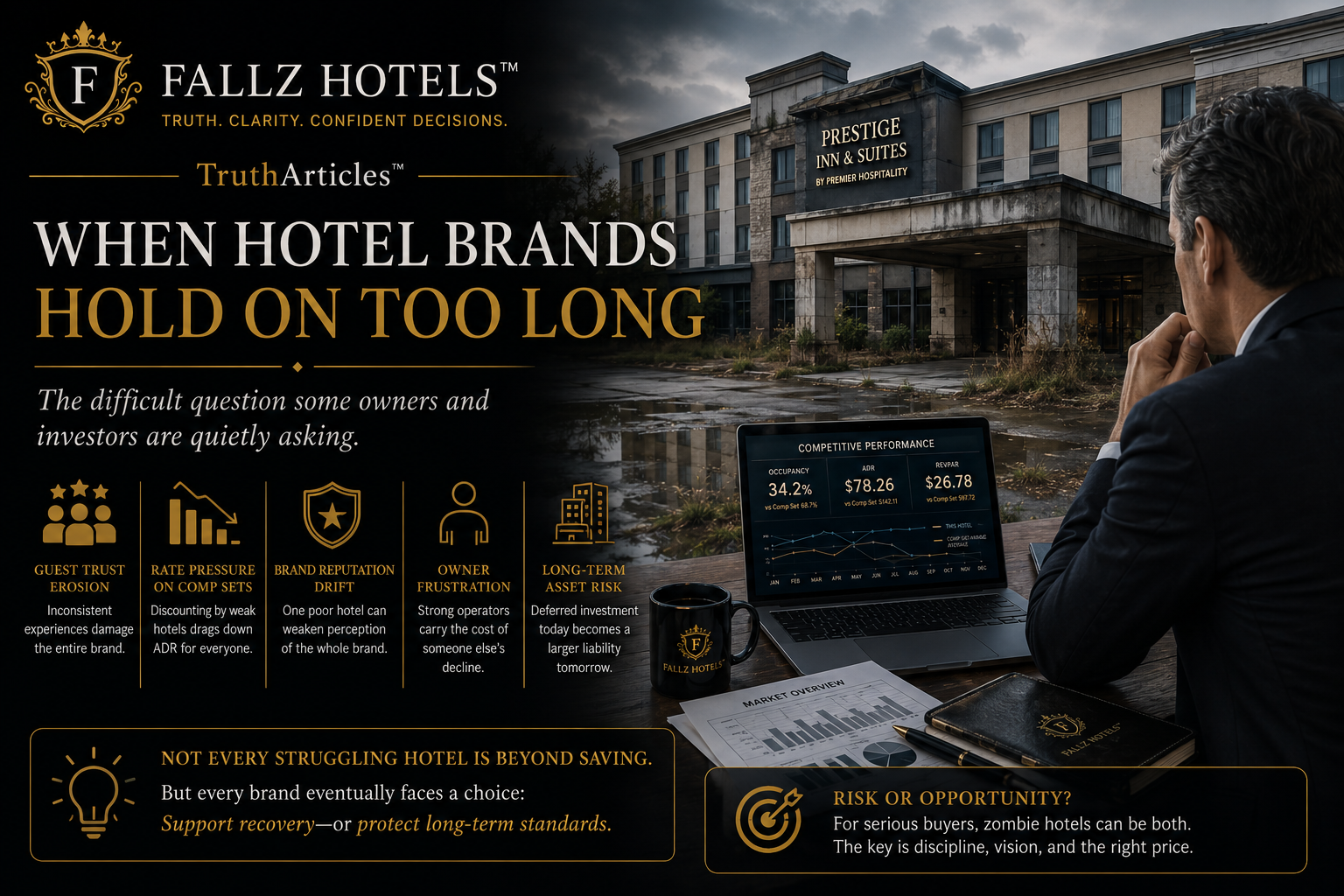
There is a quiet conversation happening in hotel ownership circles.
Not always publicly.
Usually privately.
Over dinners.
Investment meetings.
Quiet conversations between owners.
And the question sounds something like this:
“How is that hotel still carrying the flag?”
The property looks tired.
Guest reviews feel inconsistent.
Rates keep dropping.
Staff turnover feels constant.
And yet—
the brand remains.
For many owners and investors, this raises a more difficult question:
Not just the property itself.
The market.
The comp set.
Guest trust.
And sometimes—
the brand itself.
To be fair—
hotel brands face a difficult balancing act.
Most franchisors genuinely want struggling hotels to recover.
Ownership challenges happen.
Markets soften.
Labour issues emerge.
Unexpected disruptions occur.
And strong brands often believe:
“With support, this property can improve.”
Sometimes—
they are right.
Many hotels successfully reposition.
Renovate.
Recover.
Return stronger.
That part deserves acknowledgment.
But sometimes—
recovery drifts into something else:
Extended underperformance.
And that is where tension quietly grows.
Every hotel brand eventually faces a difficult question:
Because removing a flag is rarely simple.
There are contracts.
Relationships.
Legal considerations.
Market strategy.
Long-term development plans.
And sometimes—
the practical reality that maintaining presence in a market still matters.
But owners quietly notice something else.
When weaker properties linger too long:
The brand experience becomes inconsistent.
And inconsistency slowly changes perception.
This part matters more than many realize.
Guests book brands because they expect consistency.
Not perfection.
Consistency.
They believe:
“I know what this experience should feel like.”
But when a visibly struggling hotel remains under the flag:
• maintenance slips
• service weakens
• cleanliness becomes inconsistent
• guest confidence erodes
And importantly—
guests rarely separate:
“That hotel”
from
“The brand.”
One poor experience quietly affects trust in the larger system.
That cost compounds.
Over time.
This is where stronger hotel owners often feel frustration.
Because one struggling branded property can quietly affect an entire comp set.
Sometimes through:
• aggressive discounting
• inconsistent standards
• weakened guest perception
• compressed ADR expectations
Owners investing heavily into:
Renovations.
Service.
Training.
Brand execution.
Sometimes quietly wonder:
“Why are we carrying the cost of someone else’s decline?”
That feeling is more common than many realize.
Especially among high-performing operators.
Sophisticated buyers often look at these properties differently.
Because struggling hotels create two very different reactions:
Deferred maintenance.
Reputation issues.
Staff instability.
Guest trust erosion.
Capital intensity.
Right price.
Operational reset.
Reflagging potential.
Fresh positioning.
New leadership.
Strong market fundamentals.
Experienced hotel investors understand:
Sometimes the weakest-looking assets quietly become the strongest turnaround stories.
But only—
with discipline.
Capital.
And clear strategy.
To be fair—
this conversation is rarely black and white.
Brands are balancing difficult realities too.
Support ownership?
Protect standards?
Preserve market share?
Enforce change?
Every decision carries consequences.
Which makes this less about blame—
and more about balance.
Because eventually—
every brand faces a difficult question:
That answer is rarely simple.
Owner:
“I do not understand how they are still carrying the flag.”
Investor:
“Maybe the better question is…”
(Pause)
Investor:
“Who is benefiting from keeping it there?”**
That thought—
quietly—
changes how many people look at markets.
Not every struggling hotel should lose its flag.
And not every difficult period signals permanent decline.
Hospitality is cyclical.
Recovery happens.
Strong turnarounds happen too.
But experienced owners and investors eventually understand something important:
Standards matter.
Consistency matters.
Guest trust matters.
And sometimes—
protecting the long-term health of a brand means asking harder questions earlier.
Because eventually—
every market quietly notices when a hotel stops representing what the brand promised.

Many hotel owners begin thinking about the next chapter years before they ever make a decision.
Sometimes the first step is simply understanding what options may exist — quietly and without pressure.
Private hotel conversations.
Before anything becomes public.
Oakville, Ontario, Canada
Private conversations. No public listings.
Your information is handled with care — always.