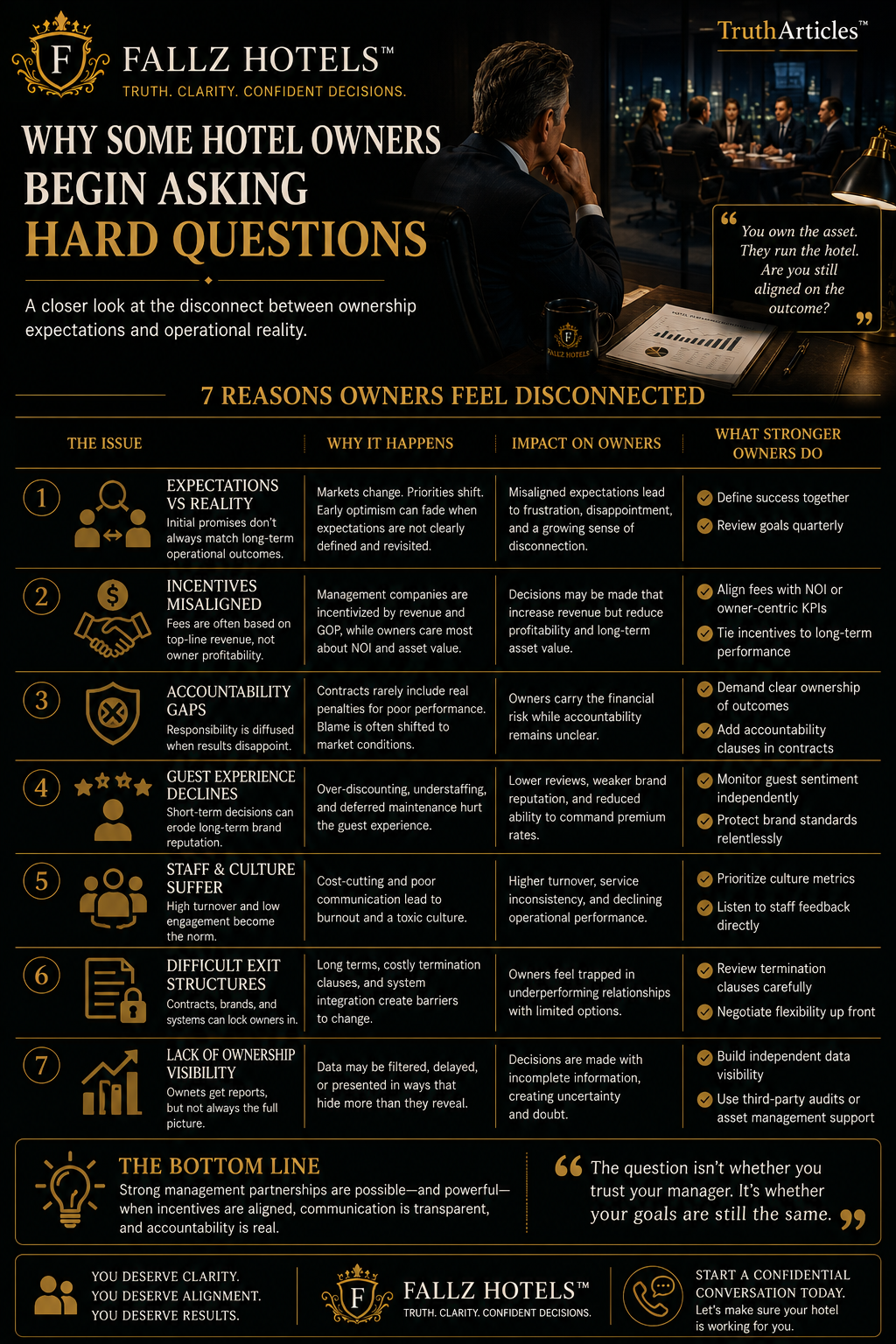
Hiring a hotel management company is supposed to create confidence, structure, and stronger performance. But for some owners, a difficult question quietly begins to surface over time: “If I own the hotel… why does it feel like I understand it less than ever?”

At some point, many hotel owners ask a quiet question they never expected to ask:
“How did I become the person furthest away from my own hotel?”
Not dramatically.
Quietly.
Gradually.
The reports still arrive.
Meetings still happen.
Budgets still get reviewed.
Yet somehow—
the connection feels different.
More distant.
Less clear.
Especially for owners who brought in a third-party management company expecting something simple:
Better operations. Better performance. Less stress.
And sometimes—
that is exactly what happens.
Strong management partnerships absolutely exist.
But sometimes—
a different experience quietly unfolds.
Most owners bring in management support for good reasons.
Growth.
Professionalization.
Operational expertise.
Brand relationships.
Revenue optimization.
A trusted team to handle the day-to-day complexity of hospitality.
Because hotel ownership is demanding.
Constantly.
Guests.
Staffing.
Revenue management.
Reviews.
Maintenance.
Unexpected issues.
The right operator can create real value.
Many do.
But over time—
some owners begin noticing something uncomfortable:
The property still belongs to them.
Yet visibility somehow feels lower.
Not higher.
This is often where tension begins.
Not through conflict.
Through drift.
The owner believes:
“We hired professionals to improve performance.”
The operator believes:
“We are managing within market realities.”
Neither side necessarily feels wrong.
But expectations slowly separate.
Owners want:
• stronger NOI
• improving guest experience
• healthier culture
• better long-term asset value
Operators may be balancing:
• labour shortages
• market softness
• brand expectations
• staffing challenges
• budget pressure
And somewhere between those realities—
frustration quietly grows.
This is often the hardest part.
When performance feels weaker than expected—
owners naturally ask:
“Who is accountable?”
Because in many management structures:
Owners absorb most financial risk.
While operators manage day-to-day execution.
That dynamic can sometimes create emotional tension.
Especially when:
• occupancy softens
• reviews decline
• staffing weakens
• maintenance slips
• revenue growth stalls
The owner still feels the pressure.
Personally.
Financially.
Emotionally.
And over time—
many begin asking:
“Are we fully aligned?”
That question matters.
Many owners quietly describe something difficult to articulate.
It feels like:
“I still own the hotel… but I no longer feel close to it.”
The data is there.
The meetings happen.
But instinctively—
something feels off.
Especially for family-owned assets.
Hotels built through sacrifice.
Long hours.
Personal risk.
Years of effort.
Because for many families—
this is not just an investment.
It is legacy.
And emotional distance from something meaningful feels heavier than expected.
This part surprises many owners.
Changing management sounds simple.
Often—
it is not.
Because by then:
• systems are integrated
• teams are loyal to leadership
• contracts are complex
• brands may influence relationships
• operational transitions feel risky
Which leaves some owners feeling stuck.
Not trapped exactly.
Just uncertain.
And uncertainty has a cost too.
Interestingly—
some owners are beginning to rethink how oversight works.
Not by micromanaging.
Not by distrusting operators.
But by creating stronger alignment.
They ask harder questions:
• What outcomes are we truly measuring?
• Are incentives aligned with ownership goals?
• What does success actually mean here?
• Where are we improving—and where are we drifting?
• What are staff and guests quietly telling us?
Sometimes they bring in:
• asset managers
• independent performance reviews
• guest sentiment analysis
• operational audits
• stronger accountability frameworks
Not reactively.
Thoughtfully.
Because strong partnerships thrive on clarity.
Owner:
“I thought hiring management would make things easier.”
Advisor:
“Sometimes it does.”
(Pause)
Advisor:
“But easier and aligned are not always the same thing.”
That realization—
quietly—
lands hard for many owners.
Not every management relationship struggles.
Many are excellent.
Many create extraordinary value.
But experienced hotel owners eventually learn something important:
Strong hotel performance is rarely built on trust alone.
It is built on:
Alignment.
Transparency.
Shared incentives.
Honest accountability.
Because no owner wants to feel disconnected from something they worked decades to build.
And sometimes—
the most important management question is not:
“Who is running the hotel?”
But:
Many hotel owners begin thinking about the next chapter years before they ever make a decision.
Sometimes the first step is simply understanding what options may exist — quietly and without pressure.
Private hotel conversations.
Before anything becomes public.
Oakville, Ontario, Canada
Private conversations. No public listings.
Your information is handled with care — always.