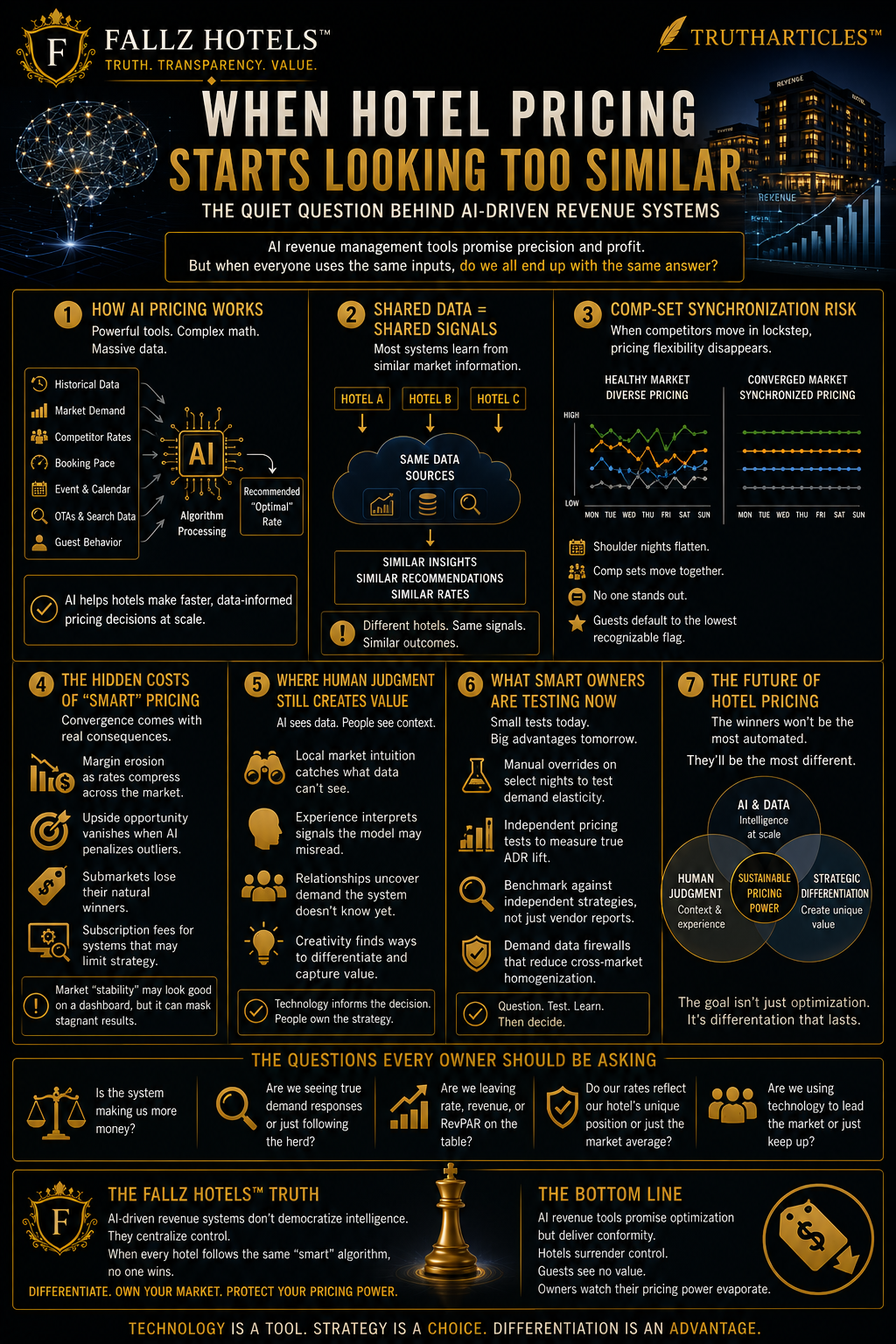
AI-powered revenue systems promise smarter pricing, stronger ADR, and more profitable decisions. And often, they deliver. But a quieter question is beginning to surface among experienced hotel owners: What happens when every hotel starts optimizing the same way?

Hospitality has changed.
Fast.
Revenue management once meant spreadsheets.
Experience.
Instinct.
Phone calls.
A sharp General Manager who knew the market better than competitors.
Today?
Pricing increasingly runs through algorithms.
Forecasting systems.
Machine learning.
Demand curves.
Real-time market signals.
And to be fair—
many of these systems are incredibly powerful.
They help hotels:
Optimize rates.
React faster.
Understand demand shifts.
Reduce human error.
Capture missed revenue.
For many operators—
revenue systems absolutely create value.
That deserves acknowledgment.
But quietly—
a more nuanced question is beginning to surface among experienced owners and operators:
Because optimization and differentiation are not always the same thing.
To understand the concern—
we first have to acknowledge reality.
Hospitality became too complex for manual pricing alone.
Demand shifts quickly.
Competitors move constantly.
Events change booking patterns.
Flights shift.
Weather matters.
Local markets fluctuate.
Modern revenue systems help hotels process information at scale.
That matters.
Especially for larger operators.
Many hotels using strong systems outperform what manual pricing could achieve.
No serious operator ignores that.
But technology also changes markets.
Sometimes in ways people do not immediately notice.
This is where the conversation becomes interesting.
Most hotel revenue systems learn from similar inputs:
Market demand.
Historical performance.
OTA behaviour.
Comp-set pricing.
Local trends.
Forecasting signals.
Again—
nothing wrong with that.
But sophisticated operators are increasingly asking:
That question deserves attention.
Because hospitality has always rewarded differentiation.
This is something some operators quietly notice.
A competitor raises rates.
Others follow.
Demand softens.
Everyone adjusts.
Compression nights move similarly.
Shoulder nights flatten.
Price movement starts feeling more synchronized.
Not identical.
But increasingly aligned.
Sometimes—
that creates stability.
Sometimes—
it reduces flexibility.
And occasionally—
owners wonder:
That distinction matters.
Hospitality has always rewarded operators who think differently.
Creative positioning.
Smarter packaging.
Market intuition.
Better guest understanding.
Timing.
Bold decisions.
But some operators quietly worry that over-automation risks something subtle:
Not because AI is broken.
Because optimization models may naturally favour predictable behaviour.
Outliers occasionally get penalized.
Risk-taking softens.
Unusual pricing strategies become less common.
Markets begin clustering around similar answers.
Which quietly raises another question:
Interestingly—
many strong operators are not rejecting AI.
They are blending it.
Using systems.
But not surrendering to systems.
They still ask:
• Does this feel right for our market?
• Does local demand tell a different story?
• Are we missing pricing opportunities?
• Are guests behaving differently than the model expects?
• What does instinct say here?
Because hospitality remains deeply human.
Data matters.
But so does judgment.
Especially in local markets.
Especially in independent hotels.
Especially when conditions change quickly.
Increasingly—
experienced operators are experimenting with:
• selective manual overrides
• independent pricing tests
• segmentation adjustments
• non-standard packaging
• unique stay incentives
• market-specific strategies
Not to replace technology.
To challenge assumptions.
Because optimization becomes stronger when operators still think critically.
Not automatically.
Perhaps the biggest question is this:
The answer may be:
Both.
AI can absolutely improve pricing.
But owners increasingly recognize:
The advantage often comes from:
How intelligently people use it.
How thoughtfully they question it.
How willing they remain to think independently.
That is where differentiation still lives.
Owner:
“The system says this is the optimal rate.”
(Pause)
Revenue leader:
“For this market…”
(Long pause)
Revenue leader:
“…or for everyone using the same model?”
That question—
quietly—
changes how some operators think.
AI pricing is not the problem.
Strong systems matter.
Smart revenue management matters.
Technology matters.
But experienced operators eventually understand something important:
Because when markets begin thinking similarly—
the strongest hotels still find ways to think differently.
And in hospitality—
Many hotel owners begin thinking about the next chapter years before they ever make a decision.
Sometimes the first step is simply understanding what options may exist — quietly and without pressure.
Private hotel conversations.
Before anything becomes public.
Oakville, Ontario, Canada
Private conversations. No public listings.
Your information is handled with care — always.