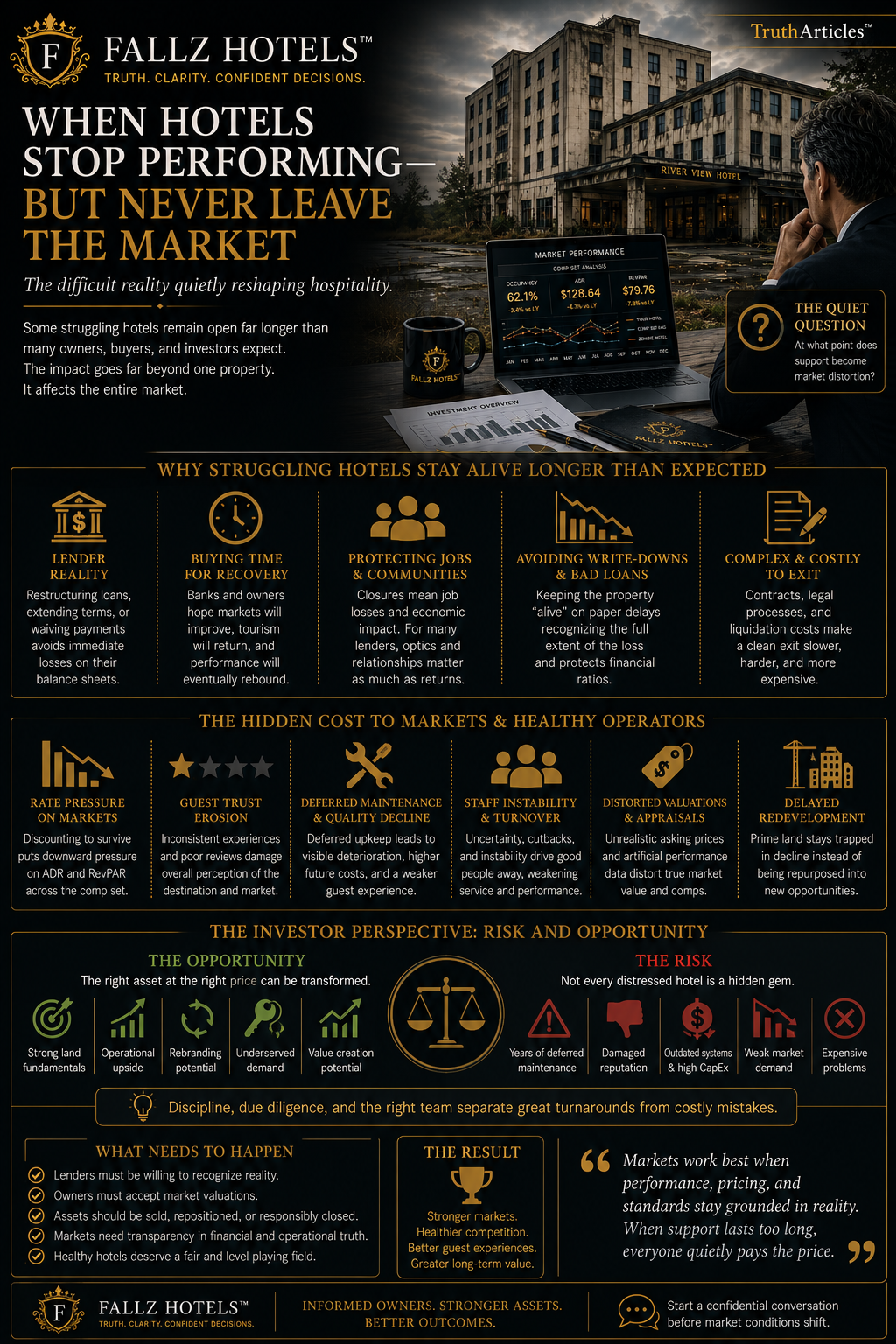
Across hospitality, some struggling hotels remain open far longer than many owners, buyers, and investors expect. The question is no longer simply “Why are they still operating?” A more difficult question may be: “What happens to the market when distressed hotels never truly exit?”

There is a quiet reality in hospitality that many owners, investors, and operators notice—
but few openly discuss.
A hotel stops performing.
Occupancy weakens.
Deferred maintenance grows.
Guest sentiment slips.
Margins tighten.
And yet—
the property remains.
Year after year.
Still open.
Still operating.
Still competing.
Which raises a difficult question:
Because while hospitality has always experienced cycles—
today, something feels different.
Many distressed hotels are lasting longer than many expected.
And quietly—
that changes entire markets.
To be fair—
not every underperforming hotel is failing.
Markets soften.
Unexpected disruptions happen.
Ownership transitions occur.
Strong recoveries happen too.
Hospitality has always been cyclical.
That deserves acknowledgment.
But sometimes—
a property moves beyond temporary softness.
The warning signs become familiar:
• declining guest experience
• mounting deferred maintenance
• aggressive discounting
• staffing instability
• inconsistent operations
• visible physical deterioration
And still—
the property remains open.
Often far longer than outsiders expect.
This part is more complicated than many assume.
Lenders, ownership groups, and operators are often balancing difficult realities.
Sometimes support continues because:
Markets may rebound.
Tourism may improve.
Operational changes may help.
New leadership may stabilize performance.
And sometimes—
that optimism proves right.
But there are also practical realities.
Closing or selling distressed hotels is rarely simple.
There are:
• loans to restructure
• contracts to navigate
• jobs to protect
• local economic implications
• difficult financial consequences
Sometimes—
support becomes a way to buy time.
Not permanently.
But long enough to see whether recovery remains possible.
That tension is very real.
This is where stronger hotel owners often begin feeling frustration.
Because struggling properties rarely operate quietly.
To survive—
many aggressively discount.
Cut corners.
Delay reinvestment.
Reduce operating costs.
And while understandable—
those decisions can ripple outward.
Healthy operators investing in:
• renovations
• service improvements
• staffing
• guest experience
• long-term positioning
sometimes quietly ask:
Especially when ADR pressure begins spreading through the comp set.
That frustration feels real.
Particularly among stronger operators protecting brand reputation and long-term value.
Guests notice too.
Even if they cannot always explain it.
A market filled with inconsistent hotel experiences slowly changes perception.
Especially when visibly tired hotels remain highly discounted online.
Guests may begin thinking:
“Maybe this market just is not that good.”
That subtle perception shift matters.
Because hospitality reputation compounds—
both positively and negatively.
One weak experience can quietly affect confidence in an entire area.
This part gets overlooked.
Employees often sense instability long before numbers become obvious.
They notice:
• supply cutbacks
• deferred repairs
• shrinking teams
• leadership turnover
• operational stress
And eventually—
many good employees quietly begin leaving.
Seeking:
Stability.
Predictability.
Growth.
Because uncertainty is difficult to work inside for long periods.
Especially in hospitality.
The ripple effects become bigger than one property.
Sometimes distressed hotels contribute to:
• downward ADR pressure
• distorted valuation expectations
• delayed redevelopment
• reduced investor confidence
• weakened market positioning
And over time—
healthy operators begin carrying more pressure than they should.
Quietly.
Interestingly—
many experienced hotel investors see something different too:
Because some distressed hotels eventually become exceptional turnaround stories.
The right investor may see:
• strong land fundamentals
• operational upside
• repositioning potential
• rebranding opportunities
• underutilized demand drivers
At the right price—
some struggling assets become extraordinary recoveries.
But disciplined buyers understand something important:
Not every distressed hotel is a hidden gem.
Some are simply expensive problems.
That distinction matters.
Owner:
“I do not understand how they are still open.”
Investor:
“Maybe the better question is…”
(Pause)
Investor:
“How long can the market support it?”**
That question—
quietly—
is becoming more common.
Not every struggling hotel should disappear.
Recovery stories exist.
Turnarounds happen.
Markets evolve.
Hospitality remains resilient.
But experienced owners and investors eventually understand something important:
Markets work best when performance, pricing, and standards stay grounded in reality.
Because eventually—
every industry faces a difficult question:
And when too many struggling assets remain suspended between recovery and decline—
everyone quietly feels the consequences.
Many hotel owners begin thinking about the next chapter years before they ever make a decision.
Sometimes the first step is simply understanding what options may exist — quietly and without pressure.
Private hotel conversations.
Before anything becomes public.
Oakville, Ontario, Canada
Private conversations. No public listings.
Your information is handled with care — always.