Hospitality has always been built around service. But across hotels today, a quieter question is emerging behind the front desk: What happens when protecting the guest experience begins hurting the people creating it?

For decades, hospitality operated under a familiar belief:
“The guest is always right.”
In many ways—
that mindset helped shape the industry.
It encouraged service.
Patience.
Attention to detail.
A willingness to go further.
And for a long time—
it worked.
But quietly—
something has shifted.
Because across hotels today, many owners, General Managers, and frontline teams are beginning to ask a harder question:
What happens when protecting the guest experience starts hurting the people creating it?
Not dramatically.
Quietly.
Repeatedly.
And often—
behind the scenes.
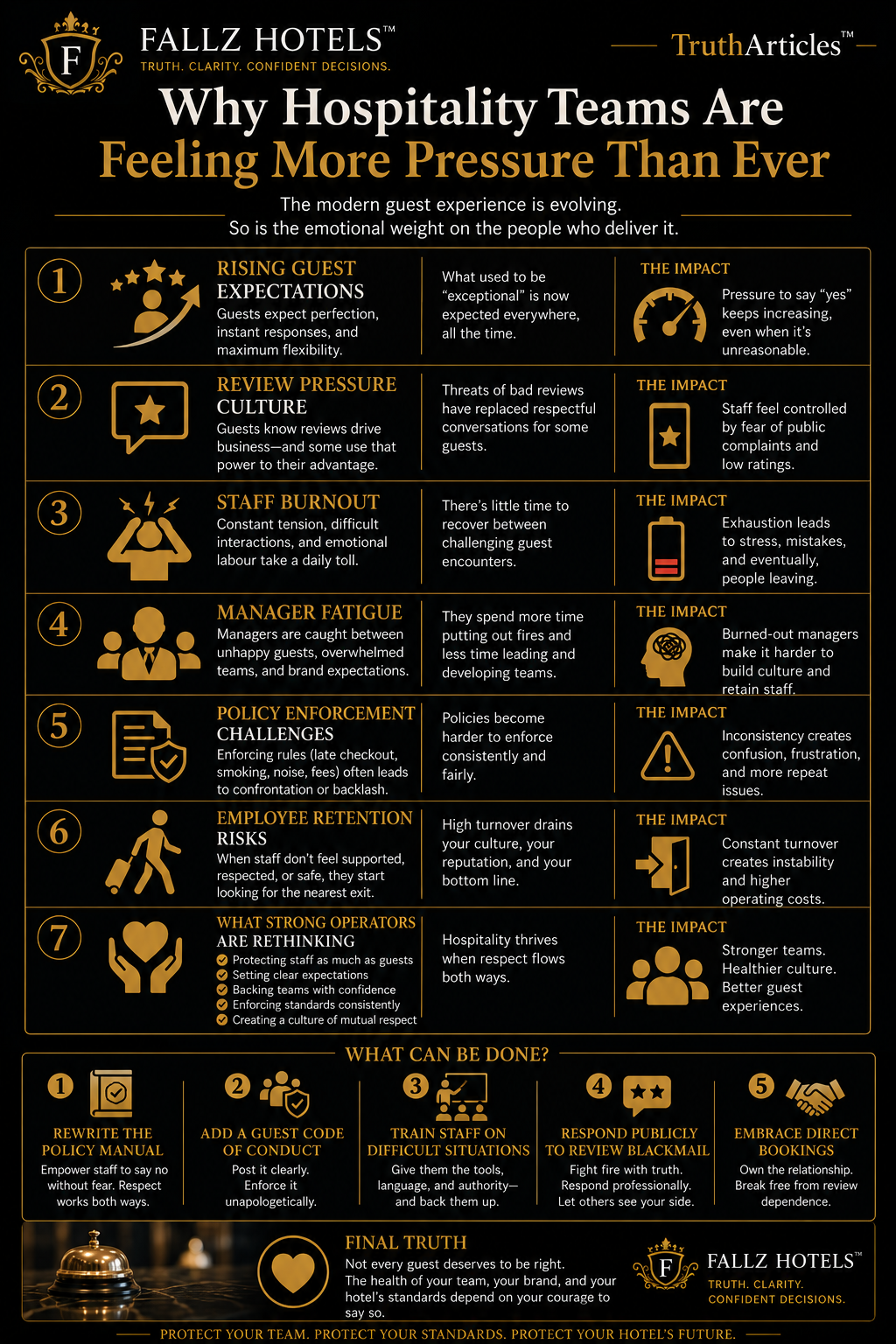
Guests today expect more than ever.
Faster responses.
Immediate fixes.
Perfect stays.
Higher personalization.
Greater flexibility.
And while much of that is reasonable—
something else quietly arrived alongside it:
Constant leverage.
Reviews.
Ratings.
Public complaints.
Social media visibility.
The emotional pressure of:
“One bad interaction could become public.”
That changes behaviour.
For staff.
For managers.
For owners.
And slowly—
many hotels began operating from a place of avoidance rather than confidence.
This part feels familiar to many hotel teams.
A difficult interaction happens.
Policy is enforced.
A request cannot reasonably be accommodated.
And suddenly:
“Fine. I’ll leave a review.”
Or:
“I’m posting this online.”
Sometimes directly.
Sometimes implied.
Not always unfairly.
But often enough that staff quietly feel it.
Especially frontline teams.
Because after enough difficult interactions—
many employees begin feeling like:
No matter what we do, someone will still be upset.
That emotional exhaustion compounds.
Housekeepers feel it.
Front desk teams definitely feel it.
Night auditors.
Managers.
Food & beverage teams.
The emotional labour of hospitality has grown heavier.
Not simply because guests changed—
because expectations changed.
And increasingly—
employees are absorbing emotional intensity all day long.
Quietly.
Repeatedly.
Often without recovery time.
Many hotel employees are not leaving only because of pay.
They are leaving because the work feels emotionally harder than it used to.
This part often gets overlooked.
Managers are carrying pressure from every direction.
Guests want flexibility.
Staff want support.
Brands want scores.
OTAs want reviews.
Owners want occupancy.
Everyone wants resolution.
Fast.
Which creates a difficult tension:
How do you protect guest satisfaction while also protecting your team?
That question feels heavier than many people realize.
Especially in independent and family-run hotels.
Something subtle happens when staff stop feeling supported.
Confidence drops.
Morale weakens.
Policy enforcement becomes inconsistent.
Burnout rises.
And eventually—
good people quietly leave.
Not necessarily angry.
Just exhausted.
Because there is a difference between:
Serving guests
and
absorbing mistreatment.
The strongest operators are increasingly recognizing that difference.
Interestingly—
some hotel owners are beginning to rethink things.
Not by becoming rigid.
Or unfriendly.
Or transactional.
Quite the opposite.
They are asking:
“How do we protect hospitality without sacrificing our people?”
Sometimes that means:
• clearer guest expectations
• stronger staff training
• empowering managers to support employees
• more thoughtful policy enforcement
• protecting teams from repeated abuse
• creating a culture where staff feel backed
Because employees notice something simple:
Whether leadership stands beside them.
That matters.
Quietly—
more than many realize.
Employee:
“I try to help… but sometimes it feels impossible.”
Manager:
“I know.”
(Pause)
Manager:
“We still want great hospitality.”
(Another pause)
Manager:
“But we have to protect our people too.”
That realization—
quietly—
is becoming more common across hotels.
Hospitality should never stop caring deeply about guests.
That part matters.
It always will.
But experienced hotel operators are beginning to understand something equally important:
Great guest experiences are built by people.
And when those people stop feeling respected—
everything eventually suffers.
Culture.
Service.
Retention.
Consistency.
The strongest hotels may not be the ones saying “yes” to everything.
They may be the ones quietly learning how to balance empathy—
with standards.
And hospitality—
with humanity.
Many hotel owners begin thinking about the next chapter years before they ever make a decision.
Sometimes the first step is simply understanding what options may exist — quietly and without pressure.
Private hotel conversations.
Before anything becomes public.
Oakville, Ontario, Canada
Private conversations. No public listings.
Your information is handled with care — always.