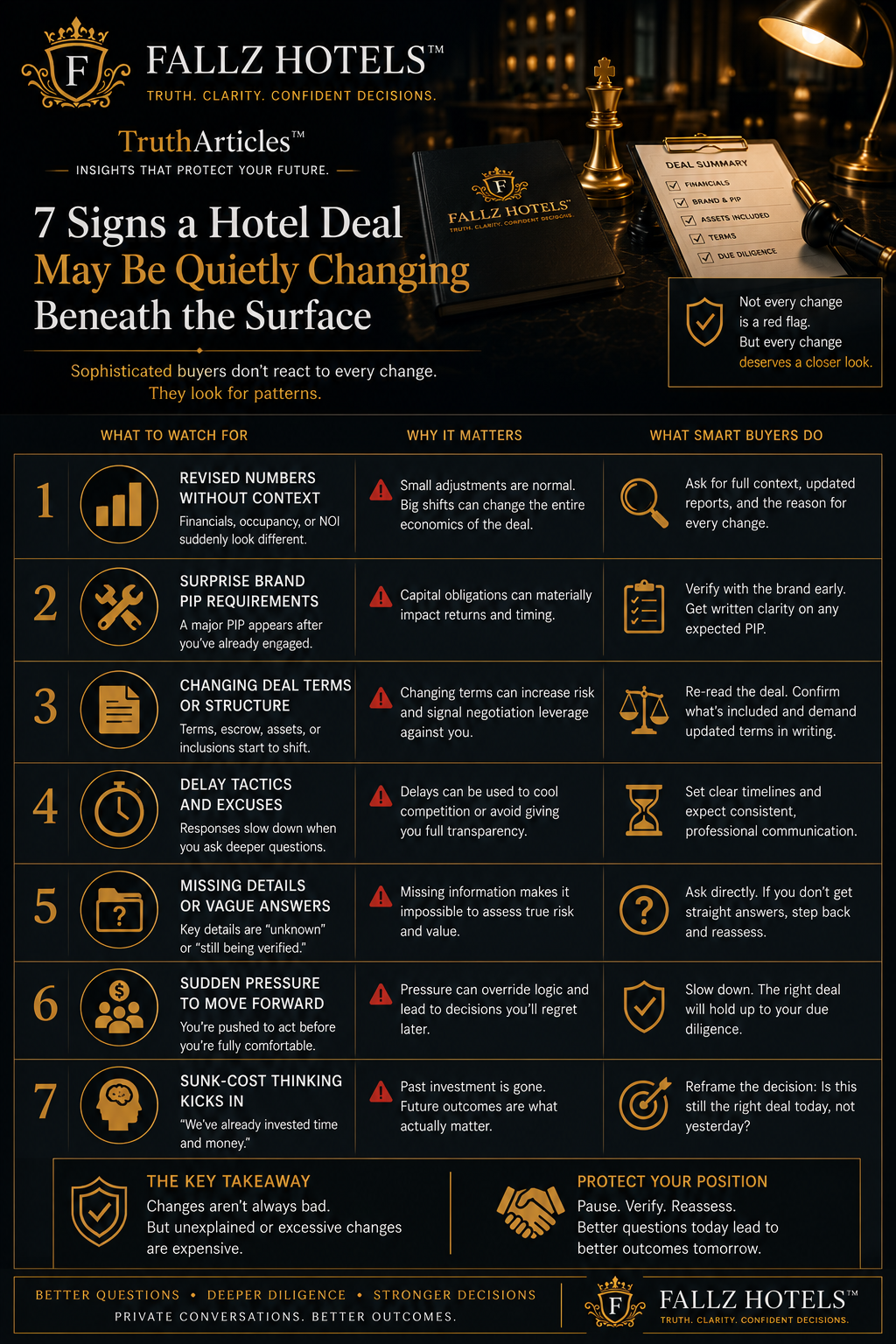
Some changes during hotel transactions are completely normal. Others quietly reshape the economics of the deal. Here is how sophisticated buyers learn to recognize the difference between reasonable adjustments and warning signs before it becomes expensive.

Most hotel deals do not fall apart dramatically.
They drift.
Quietly.
A number changes.
A timeline shifts.
A new requirement appears.
A conversation suddenly feels different.
At first—
it seems manageable.
Minor.
Understandable, even.
Because in hotel transactions, adjustments are normal.
Updated financials happen.
Operational realities emerge.
Franchise requirements evolve.
That part is business.
But sophisticated buyers eventually learn something important:
Not every change is simply “part of the process.”
Sometimes—
the deal quietly becomes something different than what originally drew you in.
And knowing when to pause becomes one of the most valuable skills a buyer can develop.
Hotel acquisitions create momentum.
You review the package.
Tour the property.
Talk strategy.
Picture improvements.
Run projections.
Begin imagining ownership.
And somewhere along the way—
emotion quietly enters the process.
Not irrational emotion.
Investment emotion.
Momentum.
Time invested.
Hope.
Excitement.
The sense that:
“We are already this far.”
That feeling matters.
Because once buyers become emotionally invested—
they often become more willing to rationalize changes.
Even when those changes deserve harder scrutiny.
Sometimes revised financials are completely reasonable.
Seasonality shifts.
Late reporting happens.
Accounting adjustments occur.
Strong buyers understand this.
But they also understand something equally important:
Context matters.
Because occasionally, numbers change in ways that materially reshape the opportunity.
Maybe occupancy trends suddenly soften.
Margins tighten.
Expenses quietly rise.
Projected NOI looks different than originally expected.
That does not automatically mean something improper happened.
But it does mean something important changed.
And sophisticated buyers ask:
“Does this still support the original investment thesis?”
Not:
“How do we make ourselves still feel comfortable?”
That difference matters.
A lot.
Few things reshape a hotel acquisition faster than a major Property Improvement Plan (PIP).
Sometimes buyers hear:
“Nothing major expected.”
Or:
“The brand relationship is strong.”
And often—
that may genuinely be the understanding at the time.
But experienced buyers avoid assumptions.
Because once formal franchise expectations arrive—
economics can shift quickly.
A manageable acquisition suddenly feels very different when meaningful capital expenditures surface.
Strong buyers learn to ask early:
• Has the brand formally reviewed the property recently?
• What renovation discussions have already occurred?
• What assumptions are we making here?
Because surprises become much more expensive after emotional attachment enters the equation.
Sometimes the property itself does not change.
The structure does.
Escrow requirements evolve.
Closing timelines move.
Assets included suddenly become less clear.
Licenses, parcels, FF&E, vendor agreements—
details start becoming more fluid than expected.
Sometimes these are normal negotiation dynamics.
Sometimes they deserve deeper attention.
Sophisticated buyers pause when they notice a pattern:
Too many important things changing at once.
Because eventually, a fair question emerges:
“Are we still evaluating the same deal?”
That question deserves honesty.
This is one of the biggest psychological traps in hotel acquisitions.
Quietly.
Dangerously.
Buyers think:
“We already invested months into this.”
“We spent money on diligence.”
“We do not want to start over.”
And suddenly—
continuing feels easier than reassessing.
Even when reassessment is exactly what is needed.
Sophisticated buyers learn something difficult:
Progress does not justify poor decisions.
Sometimes the strongest move is pausing.
Repricing.
Or walking away.
Not emotionally.
Strategically.
Sometimes it is not one major issue.
It is inconsistency.
The story shifts.
Details evolve.
Answers feel different over time.
Timelines become unclear.
Explanations start requiring more explanation.
Strong buyers pay attention to patterns.
Not isolated moments.
Because trust matters in hotel transactions.
And trust grows stronger through consistency.
Not confusion.
Buyer:
“This still feels like a good opportunity…”
Advisor:
“Maybe.”
(Pause)
Advisor:
“But is it still the same opportunity?”
That question—
quietly—
changes outcomes more than many buyers realize.
They do not panic.
They do not become cynical.
And they do not assume bad intent automatically.
Instead, they slow down.
Ask better questions.
Reassess calmly.
They understand something important:
A changing deal does not automatically mean a bad deal.
But it may mean:
A different deal.
And different deals deserve different decisions.
Not every hotel transaction unfolds exactly as expected.
That is normal.
But strong buyers understand something many people learn too late:
Momentum should never replace clarity.
Because the goal is not simply getting to closing.
It is getting to the right closing—
on terms that still make sense once the excitement fades.
And sometimes—
the smartest decision a buyer makes…
is pausing long enough to ask:
“What exactly changed here?”
Many hotel owners begin thinking about the next chapter years before they ever make a decision.
Sometimes the first step is simply understanding what options may exist — quietly and without pressure.
Private hotel conversations.
Before anything becomes public.
Oakville, Ontario, Canada
Private conversations. No public listings.
Your information is handled with care — always.