For many family-run motel and hotel owners, there is no clear retirement date—just a quiet realization that the pace they once carried is becoming harder to sustain. But when the next generation is uncertain, and the property represents decades of sacrifice, what happens next becomes far more complicated than most people realize.

There is no official retirement date in family-run hotels.
No clean exit.
No farewell speech.
No moment where someone simply hands over the keys and says:
“That is it. We are done.”
Instead, something quieter happens.
A little more fatigue in the voice behind the front desk.
A little less patience for late-night guest issues.
A little more silence after long weekends.
And eventually…
a thought that many owners quietly push aside:
“Maybe it is time.”
Not time to stop completely.
But time to slow down.
And for many hotel-owning families—
especially those who built something from the ground up—
that thought feels much heavier than most people realize.
Because slowing down sounds simple.
Until your entire identity has been tied to the property for thirty years.
Or forty.
Hotels do not pause because you are tired.
Guests still arrive.
Housekeeping still needs support.
Staff still call in sick.
Repairs still happen.
Reviews still appear online.
The business keeps moving—
whether you have the energy for it or not.
For decades, many owners simply accept this rhythm.
Morning coffee before housekeeping arrives.
Midday supplier calls.
Unexpected maintenance issues.
Evening check-ins.
Late-night complaints.
Then waking up and doing it all again.
Over time, the pace stops feeling temporary.
It becomes normal.
Then identity.
And eventually, something difficult happens:
The body starts asking for rest.
But the mind does not know how to respond.
Because slowing down feels unfamiliar.
Sometimes even uncomfortable.
In many families, the next generation notices the change before the parents do.
They notice:
• The exhaustion after long weekends
• The slower recovery after stressful weeks
• The frustration that appears more quickly than before
• The moments when energy simply is not what it used to be
But children carry a different perspective.
Because while they grew up in the hotel—
they did not always grow up for the hotel.
Some want completely different careers.
Some feel deeply conflicted.
Some feel guilt for wanting another life.
And some stay involved—
but without the same energy or attachment their parents had.
Not because they do not care.
But because they experienced the hotel differently.
The first generation often saw opportunity.
The second generation sometimes remembers sacrifice.
Interrupted dinners.
Parents always being needed.
Vacations cut short.
Weekends that never really felt like weekends.
And that creates a tension families rarely discuss openly.
At some point, most families begin circling around the same difficult questions.
Not directly.
Quietly.
Indirectly.
Almost carefully.
Questions like:
• Do we keep doing this?
• Should we bring in stronger management?
• Do we expand—or simplify?
• What happens if the children are not interested?
• What does stepping back even look like?
But very few families sit down and address it directly.
Instead, the conversation becomes:
“Maybe next year.”
“Let us wait until after renovations.”
“We will see what the market looks like.”
And somehow…
years pass.
For many owners, this is not really about business.
Not entirely.
Because the property represents far more than numbers.
It represents:
• Sacrifice
• Survival
• Identity
• Pride
• Stability that had to be earned
For many Indian hotel owners especially, the motel or hotel often became proof that the risk was worth it.
Proof that moving countries meant something.
Proof that difficult years turned into opportunity.
The property is not simply an asset.
It carries memory.
Meaning.
History.
So when someone casually says:
“Why not just sell?”
They are often misunderstanding the emotional weight behind the question.
Because selling can feel like something much larger.
Like closing a chapter of life.
And sometimes…
people are not ready for that.
Even when they are exhausted.
There is another side to this conversation that rarely gets discussed honestly.
Waiting has a cost.
And it is not always financial.
Sometimes it shows up as:
• Health slowly declining
• Burnout becoming normal
• Family strain that quietly builds over time
• Missed opportunities that never return
• Decisions eventually being made under pressure instead of clarity
There is a difference between holding on—
and holding on too long.
But the line between the two is rarely obvious while living inside it.
Something subtle is happening across North America right now.
A generation that built—
is beginning to slow down.
And a generation that inherited—
is not always stepping forward in the same way.
That creates a quiet but important shift.
Not dramatic.
Not loud.
But deeply meaningful.
Because for many owners, the future of the property no longer feels automatic.
And that changes everything.
Slowing down does not mean giving up.
And it does not automatically mean selling.
Sometimes it simply means understanding options.
Earlier.
Before pressure arrives.
That can mean:
• Understanding what the property is worth today
• Exploring timing while flexibility still exists
• Having honest family conversations earlier
• Creating room for choice rather than urgency
The strongest decisions rarely happen when people feel trapped.
They happen when there is clarity.
And time to think.
Child:
“You seem tired lately.”
Parent:
“No, no… just busy.”
(Pause)
Child:
“You have been saying that for years.”
(Long silence)
Parent:
“We just always thought we would keep going.”
That silence…
quietly lives in more hotel families than people realize.
Family-run hotels build something meaningful.
Stability.
Opportunity.
A future that once felt uncertain.
But they also ask for something in return.
Time.
Energy.
Presence.
And eventually, many owners reach a moment they never really planned for:
The realization that slowing down may no longer feel optional.
That moment does not need to feel rushed.
But it does deserve honesty.
Because the earlier families begin understanding what comes next—
the more control they often keep over how the next chapter unfolds.
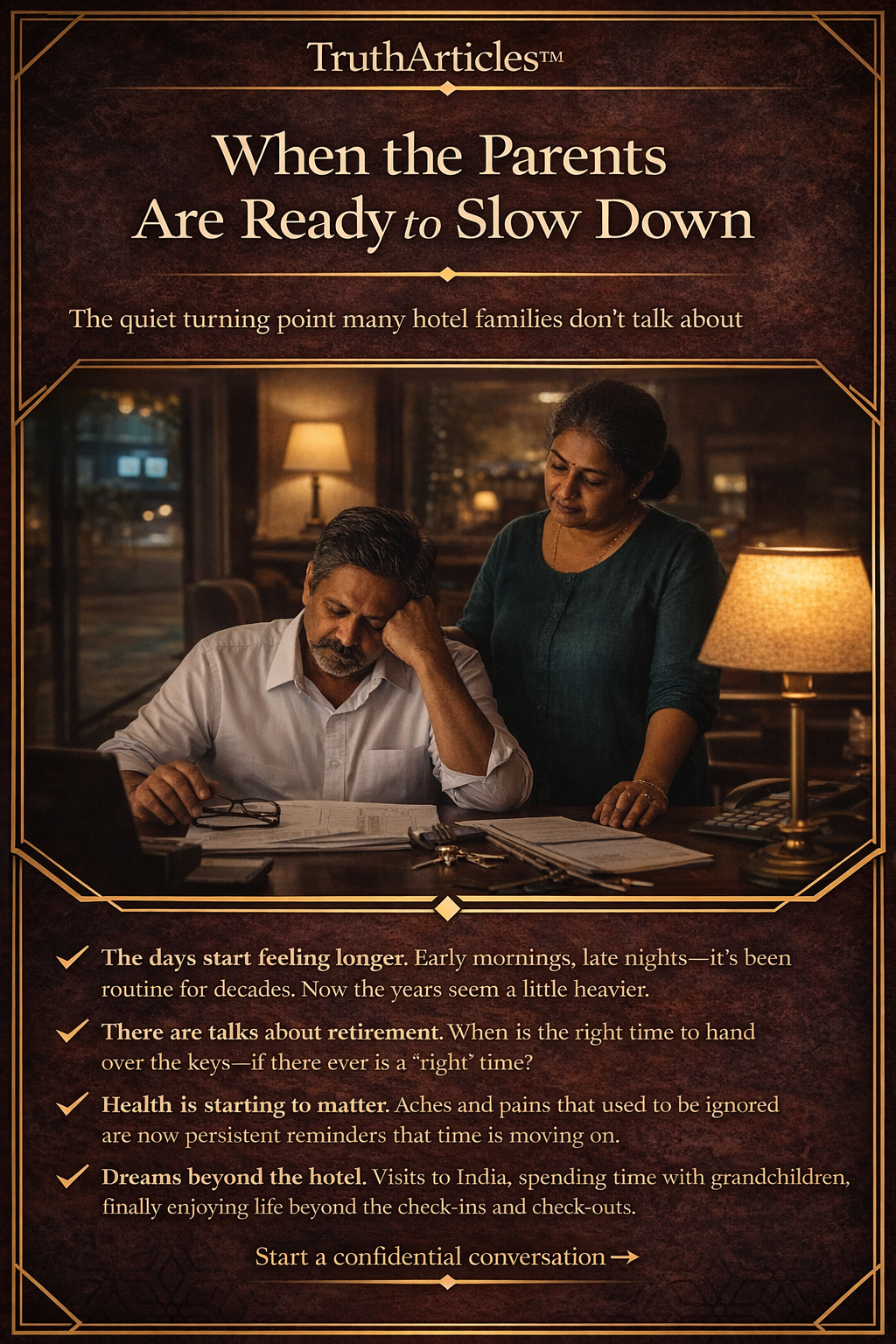
Many hotel owners begin thinking about the next chapter years before they ever make a decision.
Sometimes the first step is simply understanding what options may exist — quietly and without pressure.
Private hotel conversations.
Before anything becomes public.
Oakville, Ontario, Canada
Private conversations. No public listings.
Your information is handled with care — always.