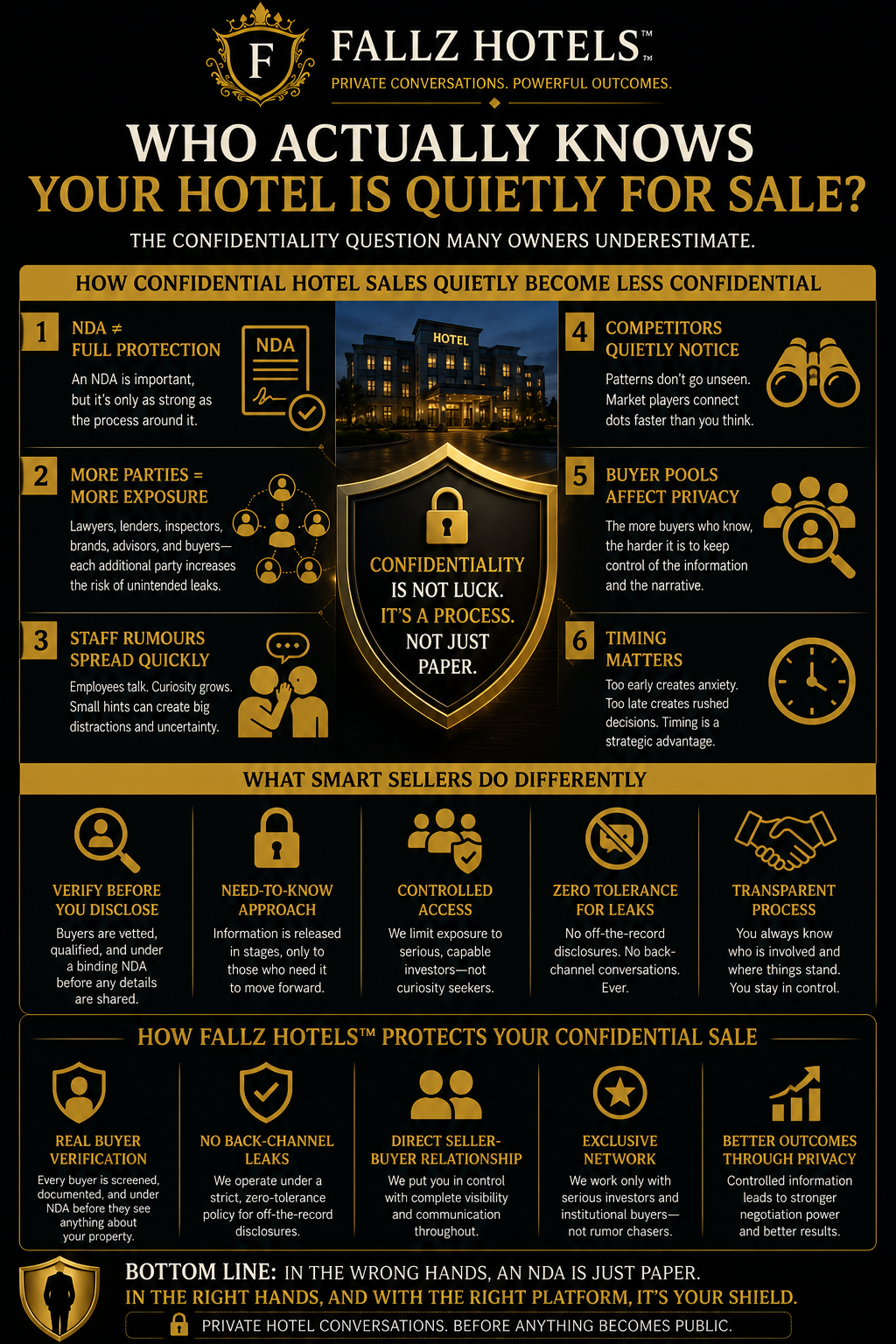
Many hotel owners assume a signed NDA guarantees confidentiality. But experienced sellers increasingly understand something quieter: confidentiality is not just a document—it is a process. And once too many people become involved, privacy becomes harder to protect.

For many hotel owners—
the biggest fear is not the sale itself.
It is exposure.
Staff finding out too early.
Competitors hearing rumours.
Guests noticing change.
Lenders asking questions.
Brands becoming concerned.
Suppliers talking.
Community whispers starting.
Especially in hospitality—
where people talk.
Quietly.
Often.
And fast.
Which raises an important question many owners underestimate:
Because in hotel transactions—
confidentiality matters.
A lot.
Sometimes more than price.
Selling a hotel is not like selling ordinary real estate.
Hotels are living businesses.
With:
Employees.
Guests.
Franchise relationships.
Management structures.
Vendor networks.
Reputation.
Long-standing local relationships.
One rumour can create unnecessary anxiety.
Staff begin worrying.
Managers speculate.
Competitors pay attention.
Guests sense uncertainty.
Sometimes—
strong businesses become distracted long before a sale even happens.
That risk feels real.
Which is exactly why privacy matters.
This is where many owners feel reassured.
An NDA gets signed.
Confidentiality language exists.
Everyone agrees information remains private.
That matters.
Strong NDAs absolutely help.
They create accountability.
Clear expectations.
Professional boundaries.
But experienced owners eventually realize something important:
It is part of confidentiality.
Not the whole system.
Because privacy becomes harder to protect once more people become involved.
Sometimes owners think:
“Only a few people know.”
Then gradually—
the circle widens.
Potential buyers.
Lenders.
Lawyers.
Inspectors.
Brand representatives.
Management teams.
Financial reviewers.
Advisors.
Third-party vendors.
And before anyone intends harm—
market awareness quietly grows.
Not necessarily because anyone acted improperly.
Because more participation naturally creates more visibility.
That distinction matters.
This part surprises many owners.
Hotel circles are often tight.
Especially in:
Ontario.
Regional hotel markets.
Family-owned hospitality groups.
Brand ecosystems.
Word travels.
Quietly.
Sometimes through harmless conversation.
Sometimes through operational curiosity.
Sometimes through patterns people notice:
“Why are investors touring?”
“Why are financial requests happening?”
“Why are ownership questions suddenly coming up?”
No announcement is required.
People often connect dots themselves.
That reality deserves respect.
Strong confidential sales are often carefully timed.
Too much exposure too early?
Creates anxiety.
Too little structure?
Creates confusion.
The strongest sellers think intentionally about:
• who actually needs to know
• when disclosure becomes necessary
• how buyer access is controlled
• what information gets shared first
• how operations stay stable during discussions
Because confidentiality is not accidental.
It is managed.
Thoughtfully.
Quietly.
Professionally.
This is another conversation owners quietly underestimate.
Larger buyer pools do not always mean stronger confidentiality.
Sometimes—
the opposite happens.
The wider the exposure—
the harder control becomes.
Strong confidential processes often prioritize:
Not secrecy for the sake of secrecy.
Discipline.
Because once market awareness spreads—
it rarely reverses.
Experienced hotel owners increasingly ask:
• Who exactly will see this?
• How are buyers being verified?
• What information gets released first?
• When does the identity become known?
• How tightly controlled is the process?
• What happens if someone breaches confidentiality?
Those questions matter.
Especially when reputation is involved.
Because a hotel sale is not simply a transaction.
It is often a deeply personal business moment.
One worth protecting.
This may be the biggest lesson.
An NDA matters.
Absolutely.
But process matters more.
Because even the strongest legal document cannot fully protect:
Poor timing.
Too many conversations.
Loose controls.
Unverified buyers.
Operational gossip.
The strongest confidential sales rely on something deeper:
Smaller circles.
Verified interest.
Controlled access.
Professional timing.
Respect for the owner.
Respect for the business.
Owner:
“I just do not want everyone finding out.”
(Pause)
Advisor:
“Then the process matters as much as the buyer.”
That moment—
quietly—
changes how many owners approach a sale.
Confidentiality is rarely lost all at once.
Usually—
it fades gradually.
One conversation.
One disclosure.
One unnecessary exposure at a time.
Which is why experienced hotel owners eventually understand something important:
Because when it comes to hotel sales—
the right people knowing matters.
But equally important?
Many hotel owners begin thinking about the next chapter years before they ever make a decision.
Sometimes the first step is simply understanding what options may exist — quietly and without pressure.
Private hotel conversations.
Before anything becomes public.
Oakville, Ontario, Canada
Private conversations. No public listings.
Your information is handled with care — always.